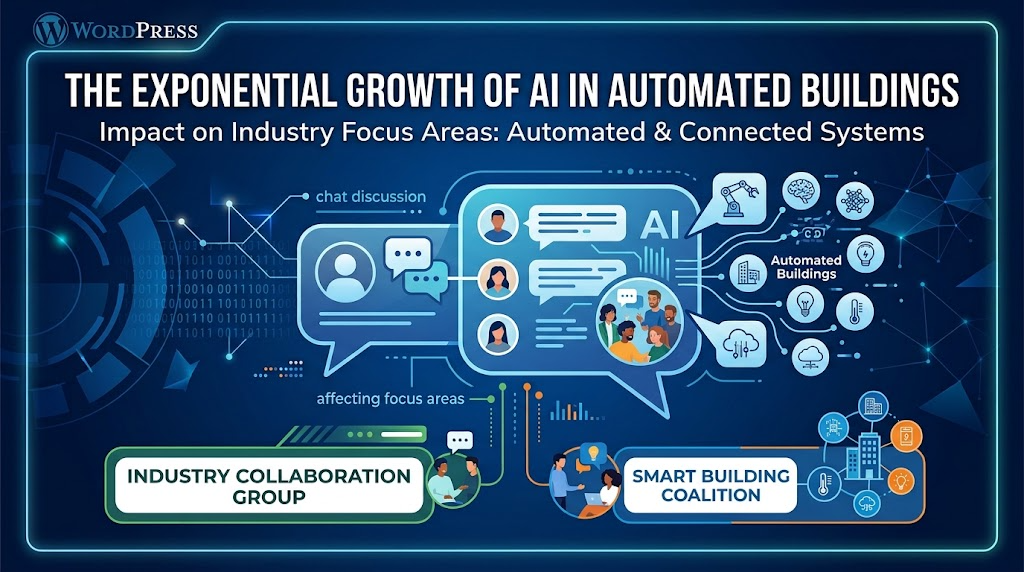
The convergence of artificial intelligence and the extensive, rapidly evolving digital building automation systems has evolved from basic algorithmic scheduling and cloud dashboards into an expansive ecosystem of physical AI, edge compute, and autonomous operation. As large models, agentic workflows, and semantic frameworks mature, the industry’s dialogue has shifted from proof-of-concept curiosity to the practical mechanics of deploying intelligence safely, securely, and at scale.
Broadening the digital landscape with AI
The range of topics demanding attention across smart building media and engineering has widened substantially:
- Physical & Agentic AI at the Edge: Moving beyond centralized cloud analytics, AI workloads are shifting to local controllers, gateways, and microcontrollers. Autonomous control loops, predictive maintenance, and local inferencing now run inside the building envelope to preserve operational resilience and lower latency.
- Semantic Interoperability & Knowledge Graphs: AI models require structured context to act safely. Standardized data schemas—including Project Haystack, Brick schema, ASHRAE Standard 223P, and emerging “graph-of-graphs” models—are now recognized as essential prerequisites for autonomous building operations.
- Energy Flexibility & Microgrid Orchestration: Dynamic real-time energy pricing, bidirectional EV charging, battery storage, and building-to-grid (B2G) communication have repositioned smart buildings as active nodes in regional power networks rather than passive energy consumers.
- Cybersecurity & IT/OT Convergence: Cloud-native architectures and software-defined buildings have intensified the need for robust zero-trust network access, secure BACnet/SC routing, and managed OT environments.
Impact on MondayLive! Focus Areas
The open, weekly roundtable format of MondayLive! has evolved in lockstep with this technical diversification:
- De-hyping AI for Practical Field Deployment: Rather than speculative discussions around generative AI, discussions emphasize practical reality: how Master Systems Integrators (MSIs) and facility managers actually implement LLMs, vision systems, and automated fault diagnostics without compromising life safety or stability.
- Open-Source Culture & Collaborative Problem Solving: The group’s discourse continues to demystify complex shifts—such as open software stacks, containerization at the edge, and vendor-neutral building operating models—through peer review, live industry commentary, and shared war stories from the field.
- Workforce & Mentorship: As building automation intersects with modern computer science, MondayLive! increasingly examines the human element—bridging the generational gap between seasoned pneumatic/DDC technicians and cloud-native software developers.
Impact on C4SB (Coalition for Smarter Buildings)
For C4SB, the proliferation of AI has transformed structural, open-standard alignment from an intellectual goal into an urgent procurement and delivery requirement:
- The Smarter Stack & Cloud-Native Foundations: C4SB’s Open Building Stack framework serves as the structural scaffolding required to keep systems from collapsing back into proprietary vendor silos when deploying AI tools.
- Semantic Tiger Teams & Data Harmonization: Because AI agents cannot interpret fragmented point names, C4SB has heavily prioritized ontology alignment (bringing together Haystack, Brick, Digital Buildings Ontology, and 223P) to provide the normalized metadata foundation machine reasoning requires.
- Division 25 Procurement Specifications: As owners demand AI-driven outcomes, C4SB is actively equipping specifiers and owners with standardized Division 25 language to ensure data ownership, open API access, and interoperability are baked into project contracts upfront.
- Interoperable Edge Architecture: Initiatives like the Interoperable Building Box (IBB) and Managed BACnet explore how on-premises compute nodes can run modern containerized workloads alongside legacy field buses.
The expansion of AI in the built environment has made it clear that algorithms are only as effective as the underlying architecture. Open communication forums and structured standards coalitions now provide the complementary layers needed to guide the industry: one fostering cultural and operational sense-making, the other laying down standard, vendor-neutral infrastructure.