
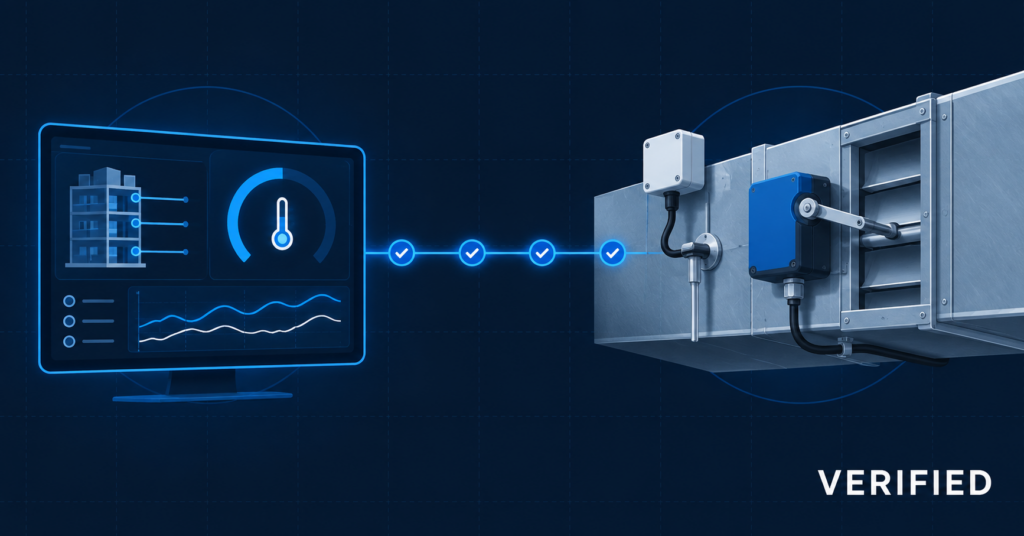
A BAS screen can look healthy while the physical building is wrong. The next step in smart buildings is not simply more data. It is making sure that the digital system actually operates the building as intended.
In building automation, “online” is an easy word. “Verified” is harder.
A controller can be communicating. A graphic can be populated. Trends can be moving. An AHU can be running. None of those conditions, by themselves, prove that the building is operating correctly or serving the needs of its occupants.
Between design intent and actual performance sit a series of handoffs: specification, procurement, installation, controls programming, commissioning and operations. At each handoff, something can change…or go wrong.
That distinction matters more as buildings systems become more complicated and connected. The more that building performance is dependent on a complicated series of interactions between physical and digital systems, the more important it becomes to robustly verify that it all works.
The U.S. Department of Energy describes commissioning as verifying and proving that systems are installed and operating according to design criteria. NIST describes building systems commissioning as a quality-control process that can improve performance when applied from design through the building lifecycle.
That is a much bigger job than checking boxes at turnover.
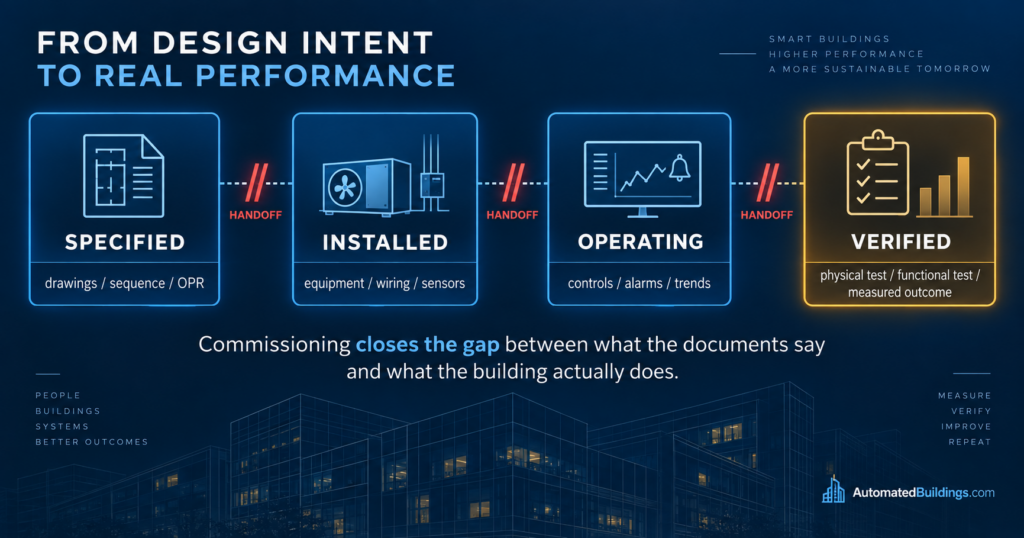
Four Different States
Specified does not mean installed
Specifications, drawings and sequences describe intent. Field conditions determine what actually gets built.
Equipment can be substituted. Sensors move because the planned location is inaccessible. Wiring changes. Control panels evolve. Sequences are revised. None of those changes automatically create a problem.
The problem begins when the as-built system and the record describing it no longer match.
For building automation, that mismatch can be especially difficult to see. A point name may still look correct even when the device, wiring, scaling or equipment relationship behind it has changed.
Installed does not mean operating correctly
A system can be complete enough to turn on and still be wrong.
An AHU can run while minimum outside-air settings are incorrect. A VAV box can communicate while its airflow value is mis-scaled. A plant can be enabled while staging logic no longer matches the written sequence.
This is one reason commissioning has to test behavior, not simply presence.
A connected device proves that communication exists. It does not prove that the device is performing the intended function.
Operating does not mean verified
This is where smart buildings can become deceptive.
A BAS graphic may display believable temperatures, pressures, airflow rates, damper positions and equipment status. A plausible value, however, can still come from the wrong sensor, an incorrect software mapping or a bad calibration.
A command can change from 0 to 100 percent on screen without proving that the physical actuator completed the stroke.
The boiler can be running when the heat pump is supposed to be serving the load.
Verified means the chain has been tested
Verification connects the digital representation back to the physical building and, ulimately, to the original specification and design intent.
For an analog input, that can mean comparing the physical condition with an appropriate reference and confirming that the sensor, controller input, engineering units, software object, graphic and trend all agree within the required tolerance.
For an output, it means issuing the approved command and observing the actual physical response.
Then the sequence is tested under the conditions it is expected to handle, including operating modes, alarms, safeties and failure conditions.
Finally, performance is verified against targets, whether those be related to space conditions, energy, carbon, etc.
Only after that chain has been checked does a BAS point become useful evidence.
What Field Verification Actually Looks Like
Good controls commissioning is systematic.
If a temperature reading does not respond as expected, the answer is not automatically “bad sensor.” The problem could be the sensing element, wiring, controller input, scaling, network path, point mapping, software database or graphic.
The job is to trace the chain until the physical condition and the digital representation agree.
The same discipline applies to actuators. Command the device. Observe the device. Confirm position or feedback where available. Then confirm that the resulting system response makes sense.
Functional testing comes after the underlying points can be trusted.
This matters because a sequence can appear to pass while operating on bad information. A control loop can be logically correct and still make the wrong decision if its inputs do not represent reality.
Once you can trust the data, trends must be reviewed to ensure that the system performance meets expectations. If not, sequences may need to be adjusted or modified. Ideally this is a process that takes place not just once, but also observes how the building behaves as conditions change, and makes adjustments as necessary to preserve performance.
Michigan Central: A Useful Reality Check
The commissioning of Michigan Central Station in Detroit offers a useful example because the deficiencies were not exotic.
The commissioning team reported AHUs and DOAS units without appropriate minimum outside-air setpoints, airflow offsets that were not maintained and contributed to negative building pressure, critical alarms that were not generating BMS notifications, and static-pressure safety switches that had not been properly calibrated.
Other findings included missing exhaust dampers and control strategies that did not match the downstream system configuration.
These were not failures of futuristic technology. They were gaps between design intent, field installation, control logic and verification.
That is precisely what commissioning is supposed to expose.
Commissioning Has to Survive Turnover
Traditional commissioning is often concentrated around construction and handover.
Buildings do not stop changing when the commissioning team leaves.
Schedules change. Tenants change. Sensors drift. Operators create overrides. Sequences are modified. Equipment is replaced. Maintenance changes system behavior.
NIST notes that HVAC performance tends to degrade over time, which is one reason it frames commissioning as a lifecycle quality-control process rather than a one-time event.
ASHRAE Standard 230-2022 and CSA Standard Z5001:26 also formalizes this direction for existing buildings and systems, including planning, assessment, investigation, implementation handoff and initial ongoing commissioning.
The economics are meaningful. A DOE-supported Lawrence Berkeley National Laboratory study covering nearly 1,500 commercial buildings found a median simple payback of about 2.2 years for existing-building commissioning projects.
The point is not that every project will deliver the same result. It is that verification can have measurable operational and financial value long after startup.
Digital Standards Are Starting to Reduce the Handoff Problem
Some of the most interesting work in building automation is now aimed at making design intent and system context more machine-readable.
ANSI/ASHRAE Standard 231-2026 defines the Control Description Language, or CDL. Its purpose is to provide a human- and machine-readable way to specify, document, simulate and exchange building control logic.
That matters because written sequences have traditionally been translated repeatedly from engineer to contractor to programmer to controller. Every translation creates another opportunity for the original intent to change.
ASHRAE Standard 223P attacks a different problem. It is still a proposed standard as of 2026. Its purpose is to create interoperable, machine-readable semantic models of building systems, including components, relationships and associated data. Building commissioning is explicitly listed among its intended applications.
UDMI, the Universal Device Management Interface, approaches the problem at the device-management layer. Its published use cases include device testability, commissioning tools, operational diagnostics, status and logging, and on-premises discovery.
None of these efforts removes the need for field verification.
They make more of the verification chain explicit, repeatable and potentially automatable.
Regulation Is Moving Toward Operational Evidence
Europe’s recast Energy Performance of Buildings Directive provides another signal.
For covered non-residential buildings, the directive requires building automation and control systems to be capable of continuously monitoring, logging and analysing energy use, benchmarking efficiency, detecting losses in system efficiency and communicating across different technologies and manufacturers. The threshold expands to systems over 70 kW by the end of 2029, subject to the directive’s technical and economic feasibility provisions.
The direction is significant.
The industry is moving beyond asking whether efficient equipment was specified and toward asking whether building systems continue to perform.
Even Rigorous Standards Still Need Post-Occupancy Verification
Passive House is useful here because it demonstrates both the value and the limits of rigorous design and certification.
A 2026 post-occupancy study of an EnerPHit retrofit and a Passive House multi-unit residential building in Ontario found meaningful differences between modeled and measured performance. In the retrofit, fan systems operating at nearly twice their design airflow were a major contributor to higher energy use.
That does not undermine rigorous standards.
It reinforces the commissioning argument.
Design quality matters. Installation quality matters. Certification matters. But operational measurement is still required to know what the building is actually doing.
The Question Smart Buildings Have to Answer
Smart-building conversations increasingly focus on analytics, AI, digital twins, autonomous control and optimization.
All of them increase the value of trustworthy building data. They also increase the consequences of bad data.
That means knowing that the correct equipment was installed, the point is connected to the correct device, the sensor reflects the real condition, the programmed sequence matches the intended sequence, the performance meets targets, and the result persists after turnover.
That is the difference between installed and verified.
In a smart building, verification and commissioning is what turns data into performance.
Further Reading from AutomatedBuildings.com
Sources and References
- NIST, Commissioning Building Systems for Improved Performance and Cybersecurity
- U.S. Department of Energy, New DOE Research Strengthens Business Case for Building Commissioning
- ASHRAE, Titles, Purposes and Scopes
- ASHRAE Standard 231 Resource Files
- UDMI Specification and Tools
- European Union, Energy Performance of Buildings Directive
- Consulting-Specifying Engineer, Project Profile: Michigan Central Station
- Energy and Buildings, Passive House and EnerPHit multi-unit residential buildings: A comparative analysis of modelled and measured energy performance post occupancy
