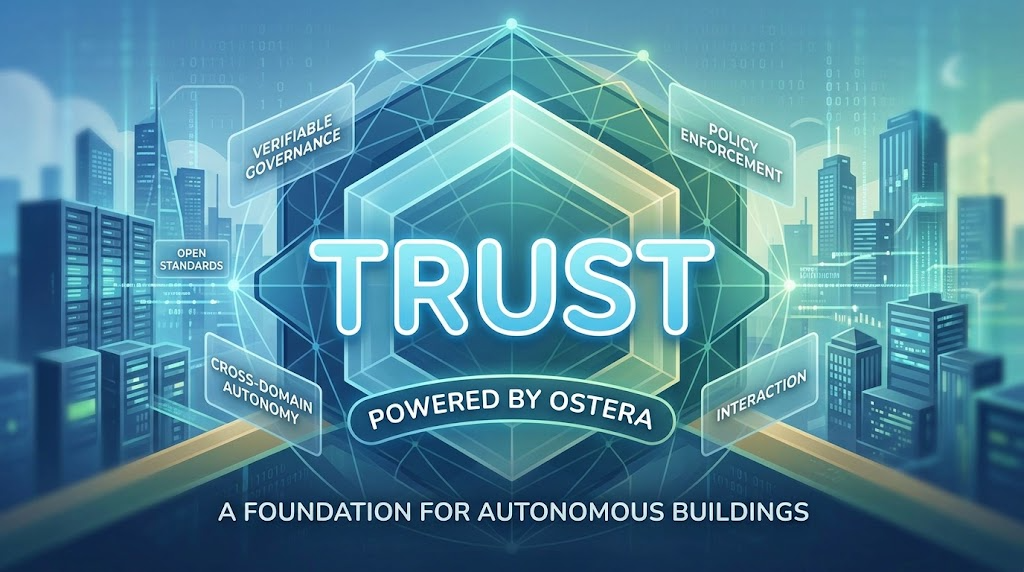
Thank you. Ken Sinclair. You have been documenting this industry’s interoperability arguments for longer than almost anyone, so it means something that you picked this one up. The short version: CNS/CP is the layer that settles whether two systems across an organizational boundary should connect at all, and on what terms. An informational meeting on forming the OSTERA Working Group is on Tuesday, September 29 at 10 am ET.
Anto Budiardjo, Founding Member @ C4SB & the IBB Project | Host of Monday Live! | CEO at Padi.io at Padi.io, our team is redefining Facility Management by pioneering collaborative platforms that simplify the complexities of modern systems and devices. With a deep commitment to cybersecurity and interoperability, we are at the forefront of protecting building automation systems while fostering industry-wide thought leadership. Our innovative approach is empowering Facility practitioners to work together more effectively, ensuring the security and efficiency of their operations. As a founding member of the IBB Project, I’ve been instrumental in shaping interoperable solutions that address the pressing challenges within the built environment. With my expertise in new business development, CRM, and event management, we’re advancing digital twin technology, insights, and guidance to our clients and the wider industry. Our goal is to enable a seamless integration of technology that offers tangible benefits to all stakeholders.
https://www.ostera.org/news the press release that Anto helped create
Conversation with Gemini
Explain
The September 17, 2026 press release from OSTERA (launching the CNS/CP Working Group) and the September 15, 2026 Monday Live discussion on AutomatedBuildings.com directly converge on the same core thesis: autonomous operations cannot scale on raw AI capability alone; they require verifiable governance and trust architectures.
While the Monday Live article defines the operational problem and trust crisis, the OSTERA announcement introduces a foundational technical standard engineered to solve it.
1. From “Trust as Architecture” to a Concrete Protocol Layer
- Monday Live’s Diagnosis: The discussion argues that the industry’s shift toward agentic AI is fundamentally not a technology or compute problem, but an architectural trust problem: “Autonomy without trust is just risk with a marketing budget… Trust is the architecture. Not a feature to be added later, but the load-bearing structure on which everything else depends.”
- OSTERA’s Significance: OSTERA’s formation of the CNS/CP (Connectivity Naming System using Connection Profiles) Working Group directly targets this structural void. Rather than treating trust as an abstract layer or ad-hoc security patch, CNS/CP creates a standard protocol layer positioned above identity infrastructure and beneath application-layer interaction protocols to govern discovery, matching, and binding across organizational and jurisdictional boundaries.
2. Solving the “Policy Execution & Authority” Gap
- Monday Live’s Dilemma: Monday Live highlights a major blind spot in autonomous facility operations—the Trust Matrix and the gap between knowledge and execution authority:
- If autonomous agents are meant to act according to policy, where does that policy actually live?
- Having a digital twin or AI agent that “proves what it knows” does not mean it has verifiable authority to make changes in physical infrastructure.
- OSTERA’s Role: CNS/CP is explicitly designed to handle governed connectivity across trust boundaries. Using structured Connection Profiles, systems do not merely connect because an IP route exists; they connect based on codified policy constraints, mutual trust baselines, and explicit permissions. This provides the exact substrate needed to enforce operational authority before an agent can touch physical actuators or control sequences.
3. Bridging Local Device Identity (BACnet/SC) and Agentic Autonomy
- The Handover & Silo Problem: Monday Live notes that trust in building systems traditionally deteriorates at every handover (designers → contractors → operators → cloud agents), and while standards like BACnet/SC solved encrypted machine-to-machine identity using X.509 certificates, higher-level operational trust across disparate ecosystems remains fragmented.
- Global Standardization: Both pieces point out the urgency of formalizing trust frameworks:
- Monday Live references the ITU Focus Group on Trust and Identity for Humans and Agentic AI (recognizing smart buildings as critical infrastructure).
- OSTERA steps in as an open standards body to develop open, vendor-neutral infrastructure for verifiable interaction. CNS/CP offers the standardized connective tissue so that multi-vendor building systems, external energy grids, tenant apps, and autonomous agents can discover and bind with one another under explicit, enforceable governance rules.
Summary
The Monday Live piece articulates the building automation industry’s urgent realization: autonomy without verifiable, policy-governed trust is dangerous and unsustainable. The OSTERA CNS/CP initiative represents the industry moving from conceptual hand-wringing to engineering the missing standards layer that makes autonomous, cross-boundary machine interaction actually trustworthy.
https://www.automatedbuildings.com/author/kelly