
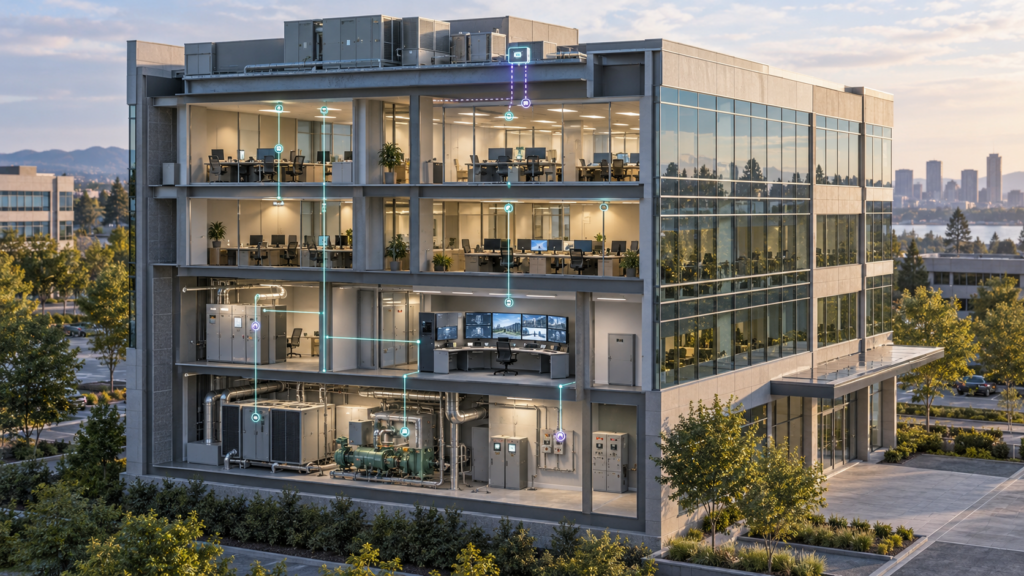
As AI moves deeper into building operations, the opportunity isn’t to replace the BMS. It’s to make better use of the systems and data buildings already have.
There’s been a lot of discussion lately about AI-native buildings and what the next generation of building automation might look like. It’s an interesting conversation, and one I think we’re going to be having for quite some time.
But there’s also a practical side to it.
Most building owners aren’t starting with a blank sheet of paper. They’re operating buildings with systems that have accumulated over many years: BMS platforms, controllers, HVAC equipment, meters, lighting systems and other technologies from multiple manufacturers. Some are relatively new. Others have been there for 10, 15 or 20 years. And much of that equipment still works.
So the question I hear isn’t necessarily “What should the building of the future look like?”
It’s more often: How do I make the building I already have smarter without replacing everything that’s in it?
I think that’s where the relationship between the BMS and the edge gets interesting.
The BMS Still Has an Important Job
I don’t see the traditional Building Management System going away anytime soon. The BMS does something very important, and generally does it very well: it provides reliable monitoring and control of critical building systems. AI doesn’t change the need for that.
What is changing is everything we’re asking the building to do beyond basic control.
Owners want better analytics. They want to optimize energy use. They want predictive maintenance, digital twins and better connections between building operations and enterprise systems. And, increasingly, they want to understand what AI can do for them.
Not all of that needs to happen inside the BMS.
An open edge layer gives owners another place for those capabilities to live while continuing to use the BMS and other systems already in place. To me, that’s an important distinction. Modernizing a building doesn’t necessarily mean replacing its control infrastructure.
AI Could Take Some of the Pain Out of Integration
Anyone who’s spent time integrating building systems knows that making the connection is only part of the job. Then the real work starts.
What does each point mean? What equipment does it belong to? What other equipment is it related to? How do you take thousands of points from different systems and turn them into information that another application can actually understand and use?
Historically, a lot of that has been manual work. It’s one of the reasons building integration can get expensive very quickly. This is an area where I think AI could have a significant impact. We’re already seeing tools that can help discover devices, interpret building data, identify relationships between assets, and automate parts of the tagging and normalization process.
I don’t think that means the engineer disappears from the equation. Far from it. Buildings are too complex for that. But if AI can eliminate some of the repetitive work involved in integration, we can spend more engineering time solving the problems that actually require engineering expertise.
There’s also a larger implication. If it becomes faster and less expensive to make existing building data usable, the business case for modernizing older buildings starts to look very different.
Connecting the Data Isn’t Enough Anymore
For a long time, interoperability in our industry was primarily about getting different systems to communicate. That’s still important. But AI raises the bar.
AI needs more than a stream of values. It needs context. A temperature reading by itself isn’t particularly useful. You need to know where it came from, which piece of equipment or space it represents, which systems are related to it, and, ideally, what’s normal for that environment.
That’s why I think we’ll hear a lot more about data normalization, metadata and semantic relationships as AI becomes more common in building operations. It also changes how we should think about the edge.
The edge doesn’t have to be just a gateway that collects information and sends it somewhere else. It can be the place where data from the BMS and other systems is brought together, put into context and made available to different applications.
The BMS keeps controlling the building. The edge helps make the building’s data more useful. That’s a fairly simple distinction, but an important one
Most Buildings Will Modernize a Piece at a Time
This may be the part of the discussion that gets overlooked. Commercial buildings don’t modernize all at once.
A facility may have an older BMS, new chillers, recently installed meters, a newer lighting system and equipment from several other manufacturers. A portfolio owner may have dozens or hundreds of buildings, each with a different mix.
You can’t wait until everything reaches the end of its useful life at the same time. And it rarely makes financial sense to replace equipment that’s doing its job simply because a new technology has arrived.
The better approach, in my view, is to create an architecture that allows new capabilities to be added around those existing investments. Maybe today that’s advanced analytics. Tomorrow it could be energy optimization or predictive maintenance. A few years from now, it could be an AI application we haven’t thought of yet.
That’s the advantage of an open architecture. You don’t have to know today exactly what you’ll want to do tomorrow.
We Don’t Know Where AI Will Be Five Years From Now
This is another reason I think openness matters. Look at how much AI has changed in just the past few years. It’s difficult to imagine anyone accurately predicting which models, applications or vendors building owners will want to use five years from now. So why design the building around that assumption?
Owners should be able to control their operational data and decide how it gets used. They should also have the flexibility to work with different applications and AI technologies as the market evolves. That makes interoperability more than a technical issue.
It becomes a business issue. An open, vendor-neutral edge layer can help provide that flexibility while allowing owners to continue getting value from the systems they already have.
It’s Not BMS Versus Edge
I think it’s easy to frame these technology changes as one thing replacing another. I don’t see it that way.
We still need the BMS. We still need controllers. We still need engineers and operators who understand how buildings actually work. What we’re adding is another layer of intelligence.
The BMS can continue to provide reliable control. The edge can help connect and contextualize information from the BMS and other systems and make that information available to an expanding range of analytics and AI applications.
That combination is what I find interesting. We’ve spent decades getting building systems connected. Now we’re starting to ask what we can do with all the information those systems produce. For building owners, that doesn’t have to begin with a major rip-and-replace project.
It can begin with the building they already have.