
How AutomatedBuildings brought independent people, architectures and one building problem into the same orbit
By Greggory Don Butler
Founder, TA-14 Authority | Contributing Editor, AutomatedBuildings.com
Something happened over the last seven months that I don’t think any of us planned.
It didn’t begin with a consortium.
There was no committee.
Nobody signed a memorandum of understanding.
Nobody agreed to merge architectures, surrender intellectual ownership or put one organization in charge of everybody else.
Instead, a group of people working on different parts of the building problem kept finding one another.
Thomas Trang.
Ken Sinclair.
Kimon Onuma.
Yong Ku Kim.
Angela Bolton.
Michael Bordenaro.
Anto Budiardjo.
And me, Greggory Don Butler, working through TA-14.
Today, we are beginning to see something that was much harder for me to see seven months ago:
A path from what an owner needs, through information and shared building meaning, across independently operated systems, through a governed connection, all the way to the moment software proposes a physical consequence inside a real building.
Not one architecture.
A chain of independently owned responsibilities.
And strangely enough, the human story of how we arrived here looks a lot like the technical architecture we are now discovering.
We didn’t become the same.
We became connected.
And there is a difference.
BEFORE THE GRAVITY, SOMEONE HAD TO NOTICE
Every chain has a first link.
For this one, his name is Thomas Trang.
Before I was a contributing editor at AutomatedBuildings, Thomas went out of his way to write about me and the work I was attempting to build through TA-14.
There was no seven-month publication record yet.
There was no Owner-to-Consequence collaboration.
There was no Connection Profile sitting beside TA-14.
There was no shared building graph.
There was no AFA interoperability experiment.
I wasn’t working with Kimon Onuma.
I hadn’t met Anto Budiardjo.
Thomas simply saw something he believed deserved to be seen.
And he acted on it.
That matters to me.
We talk constantly in this industry about infrastructure.
Networks.
APIs.
Protocols.
Ontologies.
Graphs.
Digital twins.
Artificial intelligence.
But sometimes infrastructure is something much simpler:
A human being deciding that another human being’s work deserves an opportunity to be seen.
Thomas helped put Greggory Don Butler and TA-14 in front of Ken Sinclair.
Without Thomas going out of his way to do that, I don’t know that the rest of this story happens.
That belongs in the record.
KEN SINCLAIR AND THE GRAVITY OF AUTOMATEDBUILDINGS
Around February 14-15, I entered the AutomatedBuildings community.
Ken Sinclair opened the door.
Looking backward, I think the best word I have for what Ken and AutomatedBuildings provided is:
Gravity.
Ken didn’t design TA-14.
He didn’t design Kimon Onuma’s work.
He didn’t design Anto Budiardjo’s CNS/CP or Connection Profiles.
He didn’t create Angela Bolton’s asset-information work.
He didn’t create Michael Bordenaro’s Asset Leadership Network.
He didn’t create Yong Ku Kim’s semantic work.
Ken did something different.
He created a place where independently moving people and ideas could repeatedly encounter one another.
People could publish.
Challenge.
Disagree.
Separate.
Come back.
Watch each other’s work mature.
And eventually discover that things being built independently might touch the same building problem.
AutomatedBuildings didn’t make us the same.
It brought us close enough to discover where we fit.
That distinction will become important later.
Because it is almost exactly what we are now asking independently governed building systems to do.
37 ARTICLES, ONE DEVELOPING QUESTION
After joining AutomatedBuildings, I started writing.
And I kept writing.
Week after week.
Article after article.
Thirty-seven articles in succession became a public development trail for TA-14.
They weren’t 37 articles about generic “AI governance.”
That distinction matters.
I was trying to understand AI execution governance for buildings.
What happens when intelligence stops merely informing a human and begins moving toward consequence?
The articles approached that problem from different directions.
Physical reality.
Measurement.
Environmental evidence.
Records.
Continuity.
Baselines.
Commissioning.
Admissibility.
Standing.
Authority.
Autonomous systems.
AI agents.
Execution.
At times, those subjects probably looked separate.
They weren’t.
They were progressively constructing the same question:
What has to be true before something a machine knows, infers, recommends or proposes is allowed to become physical reality?
Eventually, the architecture became clearer:
REALITY → RECORD → CONTINUITY → ADMISSIBILITY → BINDING → COMMIT → EXECUTION → OUTCOME
And underneath it sat one governing question:
Does this proposed consequence have sufficient Admissible Evidence, Applicable Authority, and Established Standing to become reality NOW?
AutomatedBuildings readers were effectively watching the question being constructed in public.
What I didn’t yet have were all the independently owned pieces immediately surrounding it.
Then September happened.
→ INSPECT THE TA-14 ADMISSIBLE EXECUTION ARCHITECTURE
KIMON ONUMA: THE FIRST ORBIT CAME BACK AROUND
Kimon Onuma and I actually spoke months earlier, around April.
It was brief.
Nothing substantial developed from it.
We went our separate ways.
That’s important because I don’t want to rewrite history and pretend this group spent seven months collaborating.
We didn’t.
But near the beginning of September, Kimon and I crossed paths again.
This time something had changed.
We both had enough actual work to put on the table.
Not just ideas.
Objects.
Building information.
RDF/Turtle.
Persistent identities.
Semantic relationships.
Governance records.
Boundaries.
And, most importantly, a real building context against which those ideas could be examined.
Kimon’s work helped expose something TA-14 should never try to own:
the durable identity and computational meaning of the building itself.
If two independently operated systems are going to reason about the same room, air-handling unit, sensor, disconnect, setpoint or asset, they need a way to know they are actually talking about the same thing.
That led us into RE1, semantic interoperability, the Semantic Bridge and what Kimon describes as a graph of graphs.
The architecture became visually simple:
RE1 BUILDING GRAPH → PERSISTENT ASSET IDENTITY ← EXPERIMENTAL GOVERNANCE GRAPH
The important word there is not “graph.”
It is independent.
The governance graph didn’t have to be merged into the authoritative RE1 building graph.
The RE1 graph didn’t have to become TA-14.
Persistent identity could allow independently governed information to meet around the same building object while provenance and responsibility remained distinguishable.
That’s interoperability without assimilation.
And it started sounding strangely familiar.
It was what the people were doing too.
→ OPEN THE ONUMA / RE1 BUILDING EXAMINATION
→ EXPLORE THE ONUMA SEMANTIC BRIDGE
YONG KU KIM: THE CONVERSATION BECOMES AN ARTIFACT
Yong Ku Kim belongs in this story for another reason.
Technical conversations move fast.
Email threads move faster.
People make distinctions, correct language, draw diagrams, reject assumptions and discover things that can disappear into a hundred-message thread by the following week.
Yong started turning that motion into something inspectable.
His Lessons Learned work captured the discussion and transformed a conversation into an artifact other people could inspect, publish, challenge and learn from.
That may sound like documentation.
It is more important than that.
If we are serious about provenance in machines, we should be serious about provenance in architecture.
What did we believe first?
What changed?
Who introduced the distinction?
Which proposition survived?
Which one failed?
What remains experimental?
What has actually been demonstrated?
A conversation becomes more valuable when its development can be examined.
Yong helped make that possible.
ANGELA BOLTON: THE OWNER CANNOT DISAPPEAR
Then there is Angela Bolton.
One of the easiest mistakes in conversations about digital twins, semantic graphs and artificial intelligence is allowing the technology to become the center of the universe.
It isn’t.
There is still an owner.
There is still an asset.
There was still an original requirement.
There is still a reason the information exists.
Angela’s asset-information perspective keeps pulling the architecture back toward that reality.
A machine-readable building object that has become disconnected from the owner’s requirement is not enough.
A beautifully structured graph that cannot preserve the information necessary to operate and validate an asset is not enough.
If we are really talking about a pathway from owner intent to consequence, then owner and asset information must survive that pathway.
That began giving us another way of seeing the architecture:
OWNER NEED → MACHINE-READABLE ASSET CONTEXT → GOVERNED CONNECTION → ADMISSIBLE CONSEQUENCE → NEW BASELINE / REVALIDATION
Now we’re not merely asking whether machines can communicate.
We’re asking whether an owner’s need can remain traceable through the systems that eventually alter the owner’s physical asset.
That’s a much harder question.
→ OPEN THE OWNER-TO-CONSEQUENCE COLLABORATION
MICHAEL BORDENARO: FOLLOW THE CONSEQUENCE BACK TO THE ASSET
Michael Bordenaro brought another scale to the discussion through the Asset Leadership Network.
Mike looked at what was happening and characterized the exchanges as “a first of their kind,” while pointing toward the possibility that this pattern could be replicated across many professions.
I think the important part is not whether history ultimately agrees with the phrase “first.”
The important part is what Mike recognized.
This wasn’t only a building-controls conversation anymore.
It was becoming a repeatable way of asking how an owner requirement survives the journey toward an actual consequence against an asset.
That is why the Owner-to-Consequence work matters.
And it is why ALN Th@3 matters to this story as more than an event on somebody’s calendar.
It creates another place where this developing path can be exposed to people who think about assets from the owner’s side rather than only from the controls side.
The architecture gets stronger every time it survives contact with another independently owned perspective.
→ FOLLOW THE OWNER-TO-CONSEQUENCE PATH
THEN I MET ANTO BUDIARDJO
About a week after Kimon and I reconnected, I met Anto Budiardjo.
And Anto exposed a hole.
We had been talking about independently maintained information referring to the same persistent building objects.
But Anto pushed into a different question.
Two systems can understand the same thing.
Does that mean they are connected?
No.
And if they are connected:
Does that mean one is authorized to cause something inside the other?
Again:
No.
Anto’s CNS/CP work and the Connection Profile forced us to separate concepts that are very easy to collapse.
A semantic relationship can establish shared meaning.
But shared meaning is not a governed relationship between independently operated parties.
That gave us the first distinction:
LINKING IS NOT CONNECTING.
A Connection Profile addresses the governed interaction between parties.
Who are they?
What is the relationship?
What is its purpose?
What is allowed to cross?
What must cross for the interaction to be meaningful?
What is outside the envelope?
How can the relationship be narrowed or revoked?
Now we have something more than two systems understanding the same building.
We have a governed connection.
But then Anto reversed the direction of our example.
And everything became obvious.
→ OPEN THE CNS/CP × TA-14 HANDOFF
CHANGE THE SETPOINT
Imagine information from a building crosses into another environment.
The receiving environment knows which building it is.
It knows which space.
It knows which equipment.
It knows the relevant setpoint.
Identity is preserved.
Meaning is preserved.
Provenance is preserved.
Nothing physical necessarily happens.
Now reverse the direction.
The external system proposes:
Change the building setpoint to 72°F.
Same building.
Same graph.
Same persistent object.
Possibly the same parties.
But we are no longer merely exchanging information.
We are proposing consequence.
Now the architecture becomes:
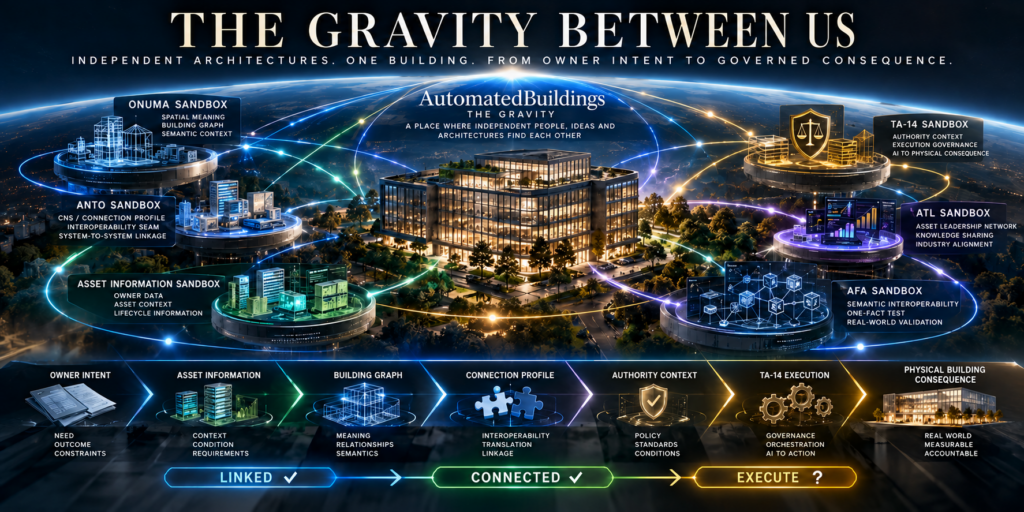
LINKED ✓
CONNECTED ✓
EXECUTE ?
That question mark is where an enormous amount of the future of autonomous buildings lives.
→ SEE WHERE CONNECTION ENDS AND EXECUTION AUTHORITY BEGINS
WHAT DOES THE CONNECTION PROFILE HAND TO TA-14?
This is the seam Anto and I are now examining.
CNS/CP should not have to become TA-14.
TA-14 should not have to become CNS/CP.
The Connection Profile should not have to become the semantic graph.
And the graph should never silently become permission.
Instead, the Connection Profile can establish the governed crossing envelope and deliver the bounded context necessary for the receiving domain to make its own determination.
What might TA-14 need at that boundary?
The proposed consequence must be identifiable.
“HVAC control” is not a consequence.
“Change this protected building setpoint to 72°F” is.
The parties and actors must remain identifiable.
The persistent object identity has to resolve the proposed action to the correct building object.
The evidence and provenance need to remain distinguishable from an assertion, recommendation or inference.
Relevant authority context may need to travel.
The scope and constraints of the interaction must remain bounded.
The receiving domain may need to establish freshness and present validity.
And it must be possible to recognize revocation or a material changed condition.
There is an important boundary around this list.
Some of these objects may ultimately belong to CNS/CP or the Connection Profile. Others may be requirements imposed by the receiving TA-14-governed domain.
That distinction is part of the examination Anto and I are working through.
We should not solve interoperability by quietly assigning one architecture’s responsibilities to another.
But one principle is already extremely clear:
Whatever crosses cannot silently become local execution authority merely because it crossed successfully.
Authority context may travel.
Execution authority must be established locally.
→ INSPECT THE CONNECTION PROFILE / EXECUTION BOUNDARY
THE PASSPORT IS NOT THE KEY
That is also why TA-14’s Admissible Federation Architecture and Authority Passport exist.
When independently governed domains interact, useful authority context may need to move with the proposal.
Who issued it?
What does it concern?
What is its scope?
Is it intact?
Is it current?
Has it been revoked?
Can its provenance be established?
An Authority Passport can carry bounded context across that federation boundary.
But the Passport is not a magic key.
It does not unlock the building simply because it arrived.
Authority can travel. Execution authority cannot be assumed.
The receiving domain retains the right and responsibility to determine what happens next.
That’s where the Execution Authority Boundary becomes visible.
And that’s where TA-14 asks:
Does this proposed consequence have sufficient Admissible Evidence, Applicable Authority, and Established Standing to become reality NOW?
Not yesterday.
Not when the connection was established.
Not when somebody issued the Passport.
Now.
→ RUN THE AUTHORITY JOURNEY
→ INSPECT THE ADMISSIBLE FEDERATION ARCHITECTURE
→ INSPECT THE EXECUTION AUTHORITY BOUNDARY
THE ONE-FACT TEST
Here’s where this stops being an architectural essay and becomes something we can actually examine.
Start with the relationship:
CNS/CP RELATIONSHIP: LEGITIMATE
Connection Profile:
VALID
Federation crossing:
ACCEPTED
Relevant evidence:
CURRENT
Present authority and standing:
ESTABLISHED
TA-14 determination:
ALLOW
Now change one material condition before protected commit.
Maybe evidence expires.
Maybe authority is revoked.
Maybe the actor’s standing changes.
Maybe equipment enters a protected state.
Maybe a safety condition appears.
Maybe the operating context that made the action admissible thirty seconds ago no longer exists.
What happens?
The CNS/CP relationship may remain:
LEGITIMATE
The Connection Profile may remain:
VALID
The building object remains the same.
The graph remains correct.
The original crossing wasn’t magically rewritten as a failure.
But TA-14 may now return:
HOLD
That is not an interoperability failure.
It may be exactly what successful interoperability looks like.
Because:
THE CONNECTION PROFILE GOVERNS THE CROSSING.
TA-14 GOVERNS WHETHER WHAT CROSSED MAY BECOME CONSEQUENCE.
The current public TA-14 showroom exposes this distinction directly: a legitimate relationship and valid Connection Profile can remain intact even when a material condition changes before commit and the resulting consequence determination changes.
→ RUN THE ONE-FACT TEST
→ OPEN THE FROZEN OPERATIONAL CHALLENGE
MONDAY LIVE: WHEN THE PIECES BECAME VISIBLE TOGETHER
Then came Monday Live.
Monday Live didn’t create this work.
That’s important.
Kimon had his work.
Anto had his.
Angela had hers.
Michael had his.
Yong had his.
TA-14 had spent months publicly developing execution governance.
What Monday Live did was bring enough of those trajectories close together that the interfaces became visible.
Kimon could point toward persistent building identity and graph-of-graphs interoperability.
Anto could distinguish linking from connecting and connection from execution authority.
Angela could keep owner and asset information in the chain.
Michael could look at the significance from an asset-leadership perspective.
Yong could turn the conversation into an inspectable artifact.
TA-14 could expose the present-tense consequence boundary.
Ken could see that the discussion itself had become something worth publishing.
The result wasn’t a new monolithic architecture.
It was something I find more interesting:
A clearer map of where independent architectures stop and another responsibility begins.
That is the architecture I trust more.
Not the architecture claiming to do everything.
The architecture capable of saying:
I stop here.
THE HUMAN ARCHITECTURE MIRRORS THE TECHNICAL ONE
Look at what happened.
Thomas didn’t become Ken.
Ken didn’t become Greggory.
Greggory didn’t become Kimon.
Kimon didn’t become Anto.
Anto didn’t become Angela.
Angela didn’t become Michael.
Yong didn’t absorb everybody’s work into a single record.
Nobody needed to.
We preserved identity.
We preserved provenance.
We established relationships.
We exchanged context.
We challenged boundaries.
And we remained independently accountable for what belonged to us.
That’s almost exactly what we are asking the machines to do.
Maybe that’s why this collaboration has moved so quickly.
We accidentally practiced the architecture before we fully described it.
FROM OWNER INTENT TO BUILDING REALITY
Put the pieces together now.
Not as a merged specification.
As a path:
OWNER INTENT
↓
ASSET INFORMATION
↓
PERSISTENT BUILDING IDENTITY
↓
SHARED SEMANTIC MEANING
↓
GOVERNED CONNECTION
↓
AUTHORITY CONTEXT
↓
LOCAL CONSEQUENCE DETERMINATION
↓
COMMIT
↓
PHYSICAL CONSEQUENCE
↓
NEW BUILDING REALITY
And then something important happens.
The new reality becomes evidence for the next decision.
The system does not simply keep acting because it was once authorized.
The building changed.
Conditions may have changed.
Evidence may have changed.
Authority may have changed.
Standing may have changed.
The next proposed consequence has to confront reality again.
Commissioned once does not mean authorized forever.
That is where continuous commissioning, semantic interoperability, governed connections and execution governance begin looking less like separate industry conversations and more like different boundaries in one lifecycle.
→ WALK THE OWNER-TO-CONSEQUENCE PATH
DON’T TAKE OUR WORD FOR IT
One thing I want this work to become increasingly resistant to is architectural theater.
Don’t believe it because Greggory wrote an article.
Don’t believe it because Kimon drew a graph.
Don’t believe it because Anto defined a Connection Profile.
Don’t believe it because somebody said “AI.”
Open the work.
The Owner-to-Consequence collaboration is being exposed publicly.
The ONUMA/RE1 work provides an earlier building evidence surface.
The Semantic Bridge exposes independently maintained semantic sources.
The AFA showroom exposes the CNS/CP-to-TA-14 handoff.
The federation lab lets the Authority Passport move while showing where authority stops.
The one-fact demonstration lets a legitimate connection remain legitimate while the consequence determination changes.
TA-14’s execution architecture remains publicly inspectable.
This article deliberately connects those surfaces so the reader can move from narrative to evidence rather than being asked to accept a retrospective description.
So here’s my invitation:
OPEN THE BUILDING.
OPEN THE GRAPH.
OPEN THE CONNECTION.
CHANGE ONE CONDITION.
WATCH WHERE AUTHORITY STOPS.
Then tell us where we’re wrong.
→ OPEN THE BUILDING
→ OPEN THE GRAPH
→ OPEN THE CONNECTION
→ CHANGE ONE CONDITION — RUN THE TEST
FROM AUTOMATEDBUILDINGS TO JAPAN
The next part of this story is already moving.
Kimon is taking his work into the buildingSMART community in Japan.
That should not be interpreted as buildingSMART adopting TA-14, CNS/CP or this emerging combined pathway.
That’s not the claim.
The interesting fact is simpler.
Ideas being exercised against real building information and independently governed interfaces here are moving into another international technical conversation.
That’s how this should work.
Not:
We solved it. Adopt our architecture.
But:
Here is what we built. Here is the boundary. Here is the evidence. Here is where it failed. Here is what survived. Now challenge it.
That’s how an architecture earns standing.
AND PEOPLE ARE WATCHING
There are people outside the immediate working group observing these conversations as well.
Parastoo Delgoshaei of NIST, whose work is relevant to building digitization and semantic interoperability, has been included in relevant correspondence.
I want to be precise about what that means.
It does not mean NIST has endorsed TA-14.
It does not mean NIST has evaluated or adopted this architecture.
And it does not make Parastoo a member of this informal working group.
It means a person working in a highly relevant research area is within observational distance of the conversation.
For now, that’s enough.
The work should earn whatever attention comes next.
SO WHAT IS THIS GROUP?
I don’t know yet.
And I’m increasingly convinced we shouldn’t rush to name it.
We’re not a standards organization.
We’re not a company.
We’re not a council.
We’re not one architecture.
What I can say is that Kimon Onuma, Yong Ku Kim, Angela Bolton, Michael Bordenaro, Anto Budiardjo, Greggory Don Butler and TA-14 have increasingly found ourselves examining different portions of the same path.
Ken Sinclair and AutomatedBuildings provided much of the gravity that allowed those relationships to form.
Thomas Trang helped set the first object in motion.
Maybe a formal name comes later.
Maybe it doesn’t.
Right now, the work matters more than the name.
Because there is something profoundly appropriate about independently governed people discovering how independently governed systems might cooperate without surrendering their identities.
WHAT CAN THE BUILDING INDUSTRY EXPECT FROM US?
Not a declaration that autonomous buildings have been solved.
They haven’t.
Not another architecture claiming ownership over the entire stack.
We don’t need one.
What I hope this group can demonstrate is a way of working.
Take a real building object.
Preserve its identity.
Preserve provenance.
Bring independently developed architectures to it.
Name the boundary.
Define what may cross.
Define what cannot.
Freeze the proposition.
Define how each side could be wrong.
Run the test.
Preserve the result.
And when something fails, don’t hide the failure.
Learn where the boundary actually is.
The future autonomous building may not belong to one platform.
Or one ontology.
Or one digital twin.
Or one AI model.
Or one controls manufacturer.
Or one governance system.
It may depend on a chain of independently accountable systems, each capable of answering for its own boundary.
And if that is where the industry is going, interoperability will have to mean much more than:
Can the systems exchange data?
Eventually the question becomes:
Can independently governed systems participate in the path to physical consequence without any one of them silently inheriting authority it was never given?
That is a much harder problem.
It is also the problem we are finally beginning to make visible.
SEVEN MONTHS LATER
I keep coming back to where this started.
Thomas Trang noticed something.
Ken Sinclair opened a door.
AutomatedBuildings gave me a place to develop a question publicly.
Thirty-seven articles followed that question toward execution.
I spoke briefly with Kimon.
We went separate ways.
Months later, we found one another again.
This time there was a building between us.
Then Yong.
Angela.
Michael.
Anto.
Monday Live.
Graphs.
RDF.
Persistent identities.
Asset information.
Connection Profiles.
Authority Passports.
Execution boundaries.
Sandboxes.
Showrooms.
Challenges.
Receipts.
And an increasingly visible path from what an owner needs to what a building actually does.
AutomatedBuildings didn’t simply report that story after it happened.
AutomatedBuildings helped create the conditions under which the people necessary to the story could find one another.
That’s why I call it gravity.
And maybe the biggest lesson from the last seven months has nothing to do with any individual architecture.
Maybe it is this:
Nobody had to surrender their architecture for the building to gain an architecture.
The graph can remain the graph.
The asset record can remain the asset record.
The Connection Profile can remain the Connection Profile.
Authority context can remain distinguishishable from execution authority.
TA-14 can remain responsible for its consequence boundary.
And every participant can remain accountable for what they actually own.
Independent.
Connected.
Inspectable.
Challengeable.
That may be what the future needs from us.
Because the building is already becoming capable of understanding more.
Soon it will be capable of doing much more.
Before that happens, we should be able to answer one final question.
Not:
Can it act?
But:
What established that it may?
OPEN THE WORK
The article ends here.
The examination doesn’t.
→ OWNER-TO-CONSEQUENCE COLLABORATION
Follow the developing ONUMA / RE1 / PAE / TA-14 path from owner need through semantic connectivity, governance, consequence and revalidation.
→ ONUMA / RE1 BUILDING EXAMINATION
Inspect the earlier building evidence work where persistent identity, represented topology and the boundary to physical intervention became concrete.
→ ONUMA SEMANTIC BRIDGE
Explore independently maintained semantic sources and the graph-of-graphs approach around persistent building identity.
→ CNS/CP × TA-14 HANDOFF
See where the Connection Profile’s permitted crossing envelope ends and the receiving consequence determination begins.
→ AFA / AVP AUTHORITY JOURNEY
Move bounded authority context across independently governed domains and inspect what federation does — and does not — establish.
→ ONE-FACT DEMONSTRATION
Begin with a legitimate connection and valid profile. Change one material condition before commit. Watch the consequence determination change without rewriting the connection as a failure.
→ FROZEN AFA × EABA OPERATIONAL CHALLENGE
Name the test. Freeze the test. Run the test. Inspect the preserved examination record.
→ TA-14 ADMISSIBLE EXECUTION ARCHITECTURE
Inspect the public execution-governance architecture behind Reality → Record → Continuity → Admissibility → Binding → Commit → Execution → Outcome.
→ ADMISSIBLE FEDERATION ARCHITECTURE
Inspect the boundary governing what authority context may cross between independently governed domains.
→ EXECUTION AUTHORITY BOUNDARY ARCHITECTURE
Inspect the boundary between received context and protected commit.
OPEN THE WORK
The article ends here.
The examination doesn’t.
Follow the developing ONUMA / RE1 / PAE / TA-14 path from owner need through semantic connectivity, governance, consequence and revalidation.
Inspect the earlier building evidence work where persistent identity, represented topology and the boundary to physical intervention became concrete.
Explore independently maintained semantic sources and the graph-of-graphs approach around persistent building identity.
See where the Connection Profile’s permitted crossing envelope ends and the receiving consequence determination begins.
Move bounded authority context across independently governed domains and inspect what federation does — and does not — establish.
Begin with a legitimate connection and valid profile. Change one material condition before commit. Watch the consequence determination change without rewriting the connection as a failure.
Name the test. Freeze the test. Run the test. Inspect the preserved examination record.
Inspect Reality → Record → Continuity → Admissibility → Binding → Commit → Execution → Outcome.
Inspect the boundary governing what authority context may cross between independently governed domains.
Inspect the boundary between received context and protected commit.
DON’T TAKE OUR WORD FOR IT.
Open the building. Open the graph. Open the connection. Change one condition. Watch where authority stops.
