I wanted to learn more about UDMI, so I chatted with my buddy Gemini. I thought it was worth sharing. Good background; looking forward to what this group is going to do
Conversation with Gemini
provide background on this group https://www.c4sb.org/udmi
The URL points to the Universal Device Management Interface (UDMI) project within the Coalition for Smarter Buildings Foundation (C4SB), hosted as a collaborative project under The Linux Foundation.
What is C4SB?
The Coalition for Smarter Buildings (C4SB) is an open-source industry alliance dedicated to digital transformation in real estate and smart infrastructure. Operating under Linux Foundation governance, C4SB brings together commercial building owners, hardware manufacturers, master systems integrators, and software providers to establish open standards, reference architectures, and vendor-neutral protocols.
What is UDMI?
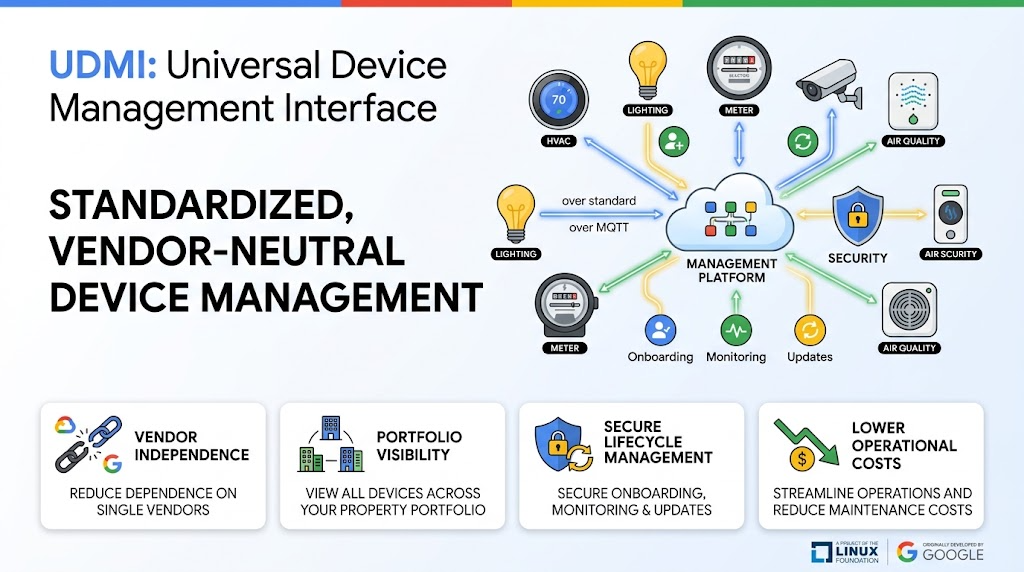
Originally developed by Google for its own real estate portfolio and subsequently open-sourced, UDMI (Universal Device Management Interface) is a standardized, high-level message specification and toolset designed to simplify how physical IoT/OT devices in buildings communicate telemetry, state, and control instructions to cloud management platforms.
The name outlines its core design philosophy:
- Universal: Applies broadly across all building subsystems (HVAC, smart lighting, energy meters, access control, and environmental sensors), avoiding proprietary, vertical-specific silos.
- Device: Manages physical hardware assets directly at the device level, rather than treating them simply as abstracted data points.
- Management: Focuses on device lifecycle needs—secure onboarding, provisioning, firmware tracking, health monitoring, and state synchronisation—rather than sub-second direct actuation.
- Interface: Defines structured, schema-validated message payloads (typically serialized as JSON over standard protocols like MQTT), allowing any vendor to integrate without proprietary SDKs.
Relationship to Legacy Building Protocols
UDMI is not meant to replace low-level field protocols like BACnet, Modbus, or KNX:
- Field-Level (BACnet/Modbus): Continues to handle local, low-latency, closed-loop machine-to-machine control between equipment and field controllers.
- Management-Level (UDMI): Operates above field protocols—often implemented on edge gateways or smart controllers—translating legacy network data into secure, structured cloud messages.
Core Objectives
- Vendor Independence: Prevents building owners from being locked into proprietary device ecosystems or closed building automation platforms.
- Portfolio-Wide Visibility: Enables multi-site property operators to manage disparate hardware across hundreds of facilities using a single schema.
- Built-in Security & Lifecycle Operations: Modernizes OT management with standard public-key authentication, encrypted channels, and configuration management that legacy field buses lacked.
- Lower Operational Costs: Streamlines automated commissioning, device validation, and error reporting.
Governance and Key Contributors
The UDMI Working Group operates through open consensus:
- Leadership & Committee: Moderated by engineers from Google (including Trevor Pering and Francesco Anselmo), alongside working committee members from major automation and engineering firms such as Siemens, Carrier, Delta Controls, Acuity Brands, Onesight Solutions, and WSP.
- Open Source Assets: The schema definitions, validator tools, and edge reference code are publicly maintained on GitHub under C4SBF/udmi.
- Community: The working group hosts open monthly community syncs and maintains a public discussion group (
udmi-discuss) for contributors and integrators.