
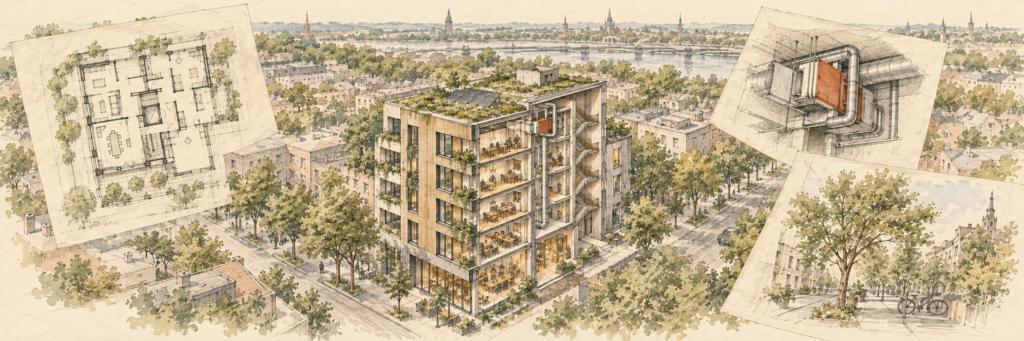
Lessons learned from one Monday Live.
One shared building model. A thoughtful exchange. A clearer picture of what it takes to move from connected information to permitted action.
A fly on the wall
Sometimes the most revealing part of a Monday Live conversation is what happens afterward.
Imagine being a fly on the wall, listening in as the conversation continues through an email exchange. Different perspectives converge on the same building, assumptions are questioned, and the picture gradually becomes clearer.
Each reply sharpened the next question. A working demonstration opened a discussion about shared meaning. That led to connection agreements, then to a deceptively simple question: even when systems understand each other, who has permission to act?
This illustrated account follows that back and forth: the questions it raised, the distinctions it clarified, and the lessons it offers for the next experiment.
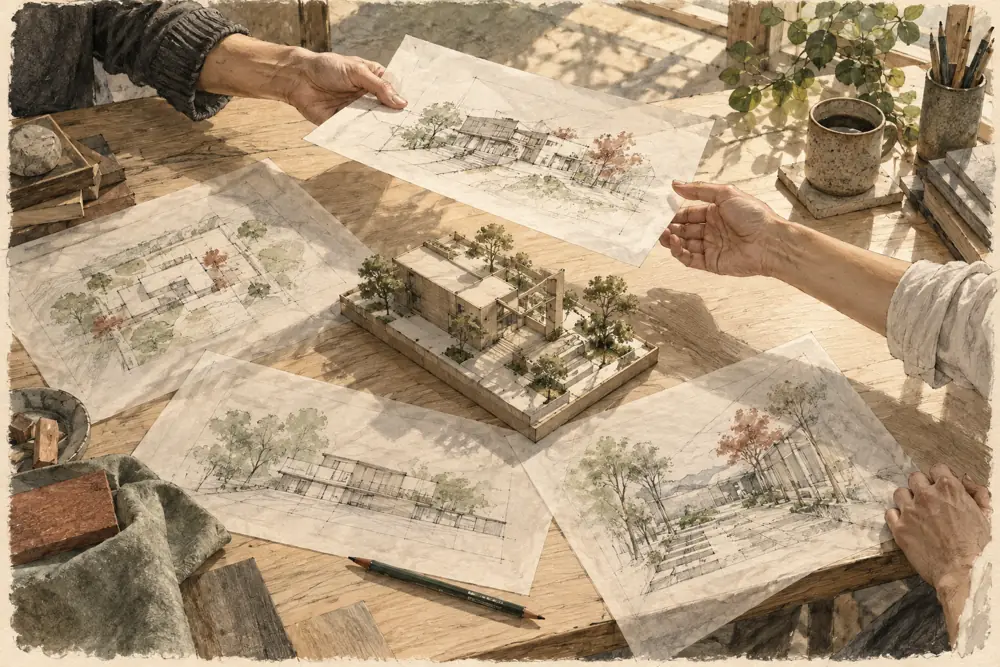
One shared starting point. A shared file gives independent people something concrete to build on. Each can bring a different question to the same building. Concept illustration.
First, recognize what already works.
Kimon Onuma began with something concrete. An RDF Turtle file from the RE1 building model had given Greggory and Angela a shared starting point for independent work. RDF describes objects and their relationships; here, persistent asset identities let different contributions refer to the same building objects.
Greggory reconciled a provisional namespace with RE1’s authoritative namespace and published a companion graph, preserving the provenance of the changes. The governance graph remained separate. Angela’s asset-information perspective added questions about completeness, reconciliation, correspondence with reality and readiness for owner use.
Kimon’s message struck a useful balance: recognize the working pieces, while being precise about what they demonstrate. Independent contributions were already connecting. The complete commercial architecture was still a work in progress.
Then, turn the question around.
Anto Budiardjo agreed that the group was underselling real progress. He then distinguished trust in the history of data from trust between organizations at runtime.
His example made the distinction tangible. Taking a copy of a building graph into another environment is one thing. Asking that environment to change a live setpoint in the PAE building is another. The objects and their meaning might be the same, but new questions appear: who may connect, for what purpose, for how long, and who can revoke the agreement?
A graph could record an authorization assertion. Anto’s follow-up question was the revealing one: who made that assertion, and why should the receiving controller accept it? The setpoint change was a thought experiment in the exchange, not a reported action.

Understanding the equipment is only the beginning. A proposed change introduces a new question: does the receiving operator permit this action, here and now? Concept illustration.
The replies made the boundaries clearer.
Greggory emphasized that collaboration had preserved ownership and attribution. RE1 remained RE1; the companion governance graph remained independently attributable. Sharing information had not transferred execution authority.
“Connection is not authority. Understanding is not permission.”
Greggory / TA-14 · Follow-up email exchange
Anto then clarified two meanings of “connection.” Graphs can be linked through shared identities. A governed connection, in his CNS/CP work, is an agreement between parties, with terms and revocation. Local permission to execute is a further responsibility.
Greggory expanded the path into five responsibilities, including the federation boundary and the authority context carried between domains. His point was that carrying that context does not establish local execution authority. Anto’s final reply brought their descriptions together in a three-layer picture.
Three layers. Three different jobs.
1. Shared meaning
Models describe objects, relationships and provenance. Each participant keeps its model.
2. Agreed interaction
A named Connection Profile defines the interaction contract. The agreement sets the terms of connection.
3. Local decision
The receiving system applies its rules to the proposed action, here and now. Each operator keeps its controls.
Adapted from Anto Budiardjo’s three-layer diagram.
Anto described the middle as a “narrow waist”: a small shared agreement between diverse models above and diverse local execution rules below. Those rules could include TA-14, a BACnet priority array, an approval workflow or a safety interlock. These were architectural examples, not claims of completed integrations.

A shared connection. Room for difference. The agreement connects participants while each retains its models and local rules. The connection does not make the two sides identical. Concept illustration.
Lessons for the next experiment.
The value of the back and forth was its increasing precision. Each reply gave a familiar word—trust, connection, authority—a more specific job.
Kimon also described switching graphs off to reveal what each contributed. Removing the ASHRAE 223 layer left objects visible while engineering meaning and relationships fell away. That suggests a useful way to explain this work: show what each layer adds, what remains without it, and what it does not authorize.
A next experiment could follow one proposed action: identify the asset, establish the connection, carry the relevant evidence and authority context, then show the receiving system’s decision. Show what changes if the agreement is revoked or a local condition is unmet.
Seen from this fly-on-the-wall perspective, the exchange shows how collaboration can make the boundaries clearer. A shared building becomes a place to test ideas together while each participant retains responsibility for its own work.
Explore the full OAI Lab account, including the six-message exchange →
The people behind the story.
Kimon Onuma & Yong Ku Kim ; RE1 building model, Semantic Bridge context and the account of the independent experiments.
Anto Budiardjo / Padi.io — Email author; CNS/CP connection agreements and the three-layer architectural explanation.
Greggory Don Butler / TA-14 — Email author; companion-graph reconciliation, governance and the distinction between authority context and local execution authority.
Angela Bolton / Fixed Asset Consultant — Contributing work discussed in the exchange; Fixed Asset Health Assessment and asset-information readiness.