We Turned a Greenbuild Audience Into a Knowledge Graph. Here’s What Happened.
Greenbuild 2026, New York City | Part 1 of a two-article series
What if, instead of talking about intelligent buildings, we asked people to become one?
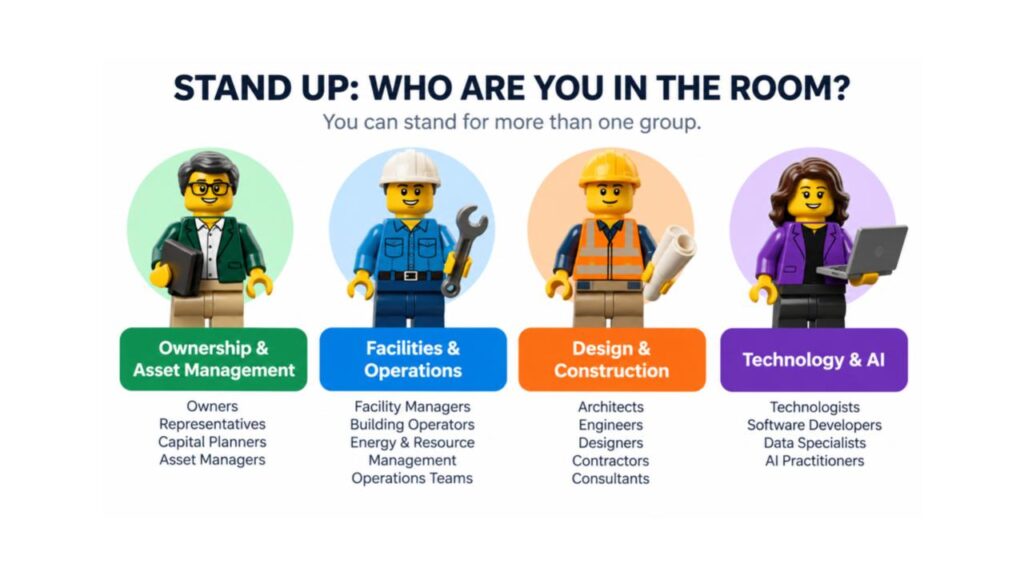
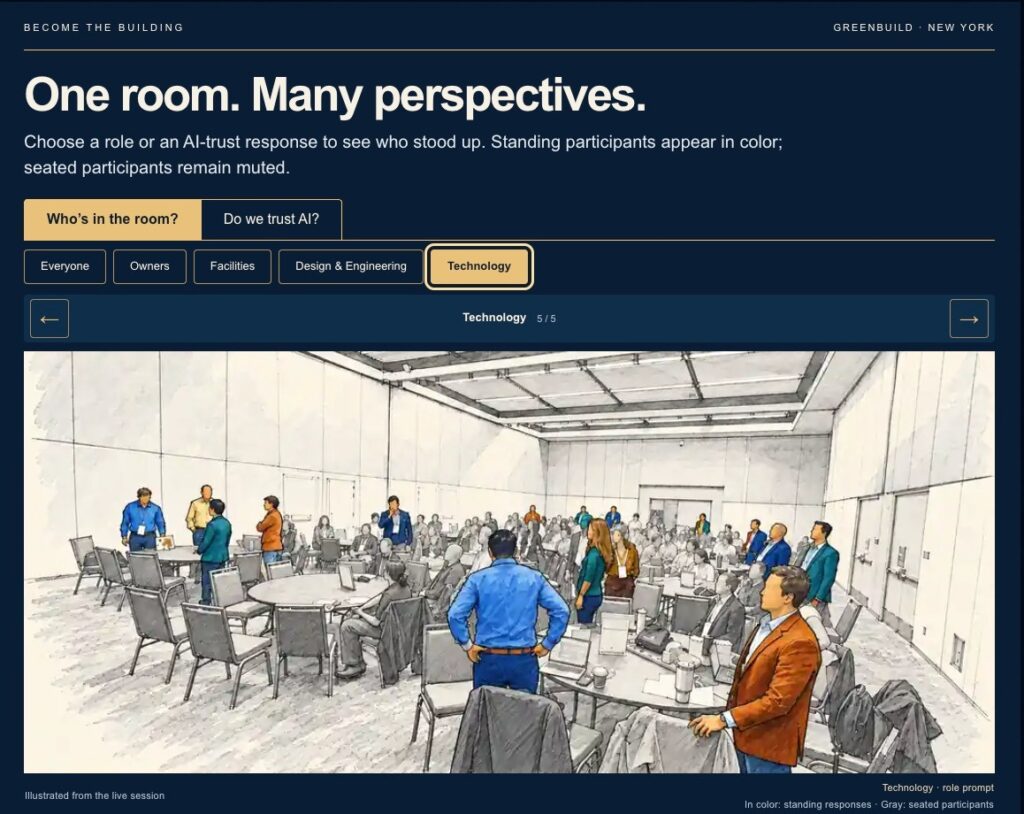
At the Greenbuild AI Summit in New York, participants became buildings, spaces, equipment, occupants, facility managers, communities, and AI agents.
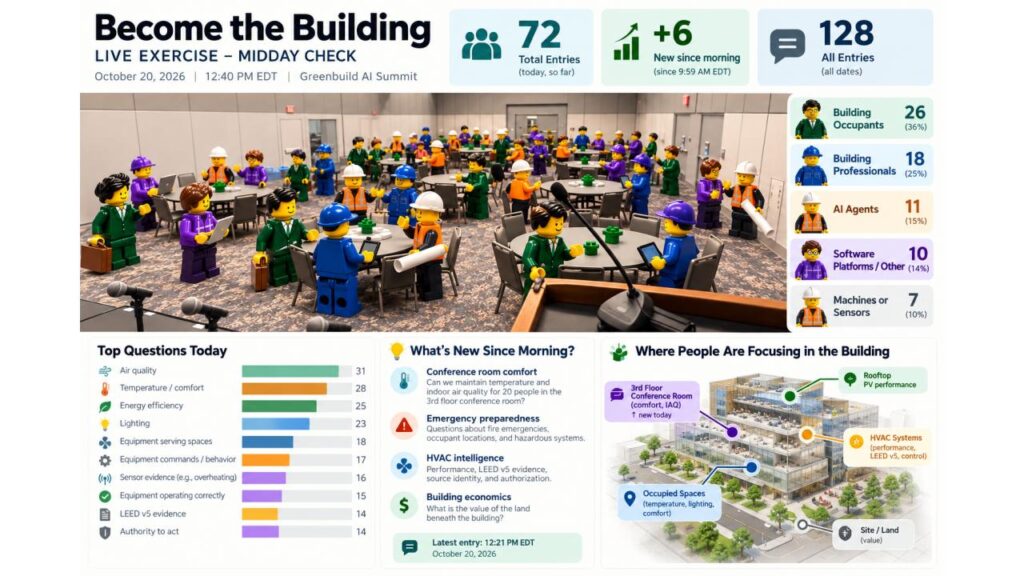
By midday On October 20, they contributed 72 submissions, asking what they needed to know, what problems they wanted to solve, and what other parts of the building they needed to connect with.
Their responses began forming a knowledge graph of questions, perspectives, and relationships.
We weren’t creating a fully operational digital twin. We were discovering what an intelligent building would need to understand.
And the questions were often more interesting than the technology.
1. Stop Talking About Smart Buildings. Become One.
We’ve spent decades describing intelligent buildings through diagrams, dashboards, BIM models, and AI presentations.
But intelligence doesn’t come from the diagram. It comes from understanding what things are, how they relate, and what people need to know.
At Greenbuild, we didn’t begin by asking what software participants wanted. We asked what they needed to know.
The audience wasn’t just watching a demonstration. They became part of it.
Explore: Become the Building exercise
2. Who—or What—Can You Trust?
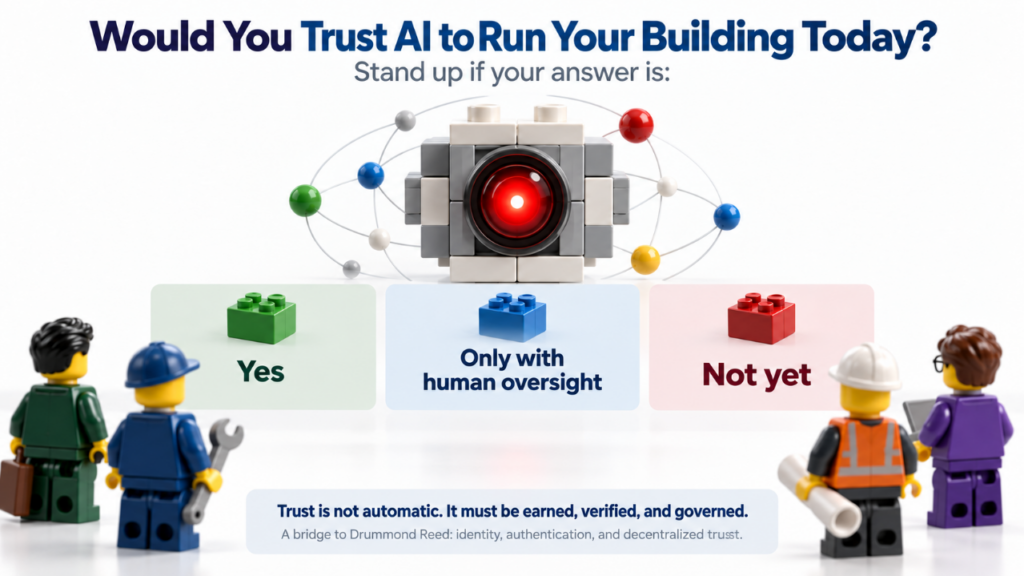
Before the exercise, Drummond Reed introduced a fundamental question: Who or what can you trust?
Humans? Machines and devices? AI agents? Trusted communities?
Drummond helped frame trust around identity, relationships, and authority, not simply cybersecurity or whether AI provides a correct answer.
That became a central theme of Become the Building.
A sensor can report a temperature. An AI agent can recommend an adjustment. A facility manager can authorize a change. Each has a different role and responsibility.
Just because systems are connected doesn’t mean they can or should trust one another.
Building intelligence requires relationships that people, devices, AI agents, and communities can understand, verify, and govern.
3. Owners Aren’t Asking for More Dashboards. They’re Asking for Answers.
One of the most revealing contributions came from Cameron Christensen of Princeton University, who also participated in the summit’s end-of-day owner panel.
Cameron asked how a building’s total cost of ownership compares with more traditional buildings of similar size and complexity, using 40-year cost per gross square foot as a measure.
Answering that requires connecting energy consumption, maintenance, equipment replacement, capital investment, and building performance.
That information rarely lives in one system.
This wasn’t a technology vendor imagining what an owner might want. It was a major institutional owner asking the question himself.
Princeton is also moving toward continuous asset condition assessment, with AI supporting asset prioritization and investment decisions.
The challenge is clear: Can we connect the intelligence owners already have well enough to answer the questions they’re actually asking?
Explore: Participant questions and insights
4. The Complexity Was Always There. Now We Can See It.
As contributions arrived, people, buildings, equipment, systems, and questions began connecting. Some relationships were obvious. Others were unexpected.
The knowledge graph didn’t create the complexity. It revealed it.
Buildings have always been interconnected systems. We’ve just spent decades managing their information in disconnected silos.
Consider an overheated room. Which sensors monitor it? Which equipment serves it? What else depends on that equipment? Are there related maintenance records? Who is authorized to respond?
Those aren’t isolated questions. They’re relationships.
The solution isn’t one giant database or one vendor’s platform. It’s preserving identities and connecting meaning across systems so people, applications, and AI agents can understand and navigate those relationships.
Participants also raised questions about energy, comfort, reliability, risk, and the broader community:
- How much energy does the building consume when unoccupied?
- Do people like being here?
- Can an air-handling unit handle the building’s load?
Different perspectives revealed different parts of the same building.
The exercise wasn’t a verified operational model. It demonstrated how human questions can help define the knowledge and relationships an intelligent building needs.
Human intelligence identified the questions. The next challenge is connecting building knowledge so those questions can be answered.
Explore: The interactive knowledge graph
5. The Best Questions Deserve Recognition.
Some participants asked questions that revealed important connections across building systems and responsibilities.
Cameron’s contribution brought long-term owner value into focus.
Justin Shultz explored mechanical equipment and abnormal operation, connecting equipment behavior to building performance.
Mandy Edwards raised questions spanning comfort, equipment operation, and multiple building systems.
Different perspectives. One common theme:
The intelligence isn’t in any one question. It’s in the connections between them.
We’re documenting contributions and identifying participants for recognition based on originality, cross-disciplinary thinking, operational relevance, and potential owner value.
Explore the Greenbuild responses
Thank you to everyone who helped discover what a building might ask if it could speak.
6. Greenbuild Was the Beginning. What Happens When Real Systems Join?
At Greenbuild, people became the building.
Now imagine connecting that thinking to actual equipment, operational data, semantic models, and AI agents.
Could an owner trace a total-cost answer through energy, maintenance, equipment relationships, and financial assumptions?
Could an operator identify not just an alarm, but what the affected equipment serves and what else might be at risk?
We’re beginning to test these questions with real building information through the PAE Living Building and related sandbox work.
The Coalition for Smarter Buildings is exploring how open standards and semantic knowledge graphs can connect building systems while preserving the identities and relationships that give information meaning.
At AHR 2027, the proposed challenge moves from imagining connections to demonstrating them.
Bring your system. Connect it. Answer a real question.
Show Us the Data. Show Us the Money. Show Us It Works.
Next in this series: Make Intelligence Green, Good for the Bottom Line (and the Planet). Why preserving building intelligence is a financial, environmental, and risk-management decision, and why owners should demand proof of interoperability.
Explore the full Become the Building project: Become the Building website