
AI is digital. Heat is physical. The controls industry has a direct role in the infrastructure that connects them.
Every watt used by a server eventually becomes heat. Removing it has always mattered in a data center, but the higher densities associated with AI are changing where heat is captured and how cooling systems must respond. For building automation professionals, the opportunity lies in making those systems dependable, from the rack to the cooling plant.
That is the focus of Data Center Boom: The Opportunity, an AutomatedBuildings.com education session planned for AHR Expo 2027.
Growth brings a harder cooling problem.
The International Energy Agency estimates that global data centers used about 485 TWh of electricity in 2025 and projects roughly 950 TWh by 2030. Berkeley Lab estimates that data centers could account for 11.8% of U.S. electricity use in 2030, with a scenario range of 9.5% to 15.3%. These are projections, but they make the scale of the mechanical challenge clear.
A facility may have electrical capacity available and still be unable to deploy more computing equipment until it can remove the heat. Cooling capacity, control stability, and failure response are therefore part of the computing capacity discussion.
The work is in the connections.
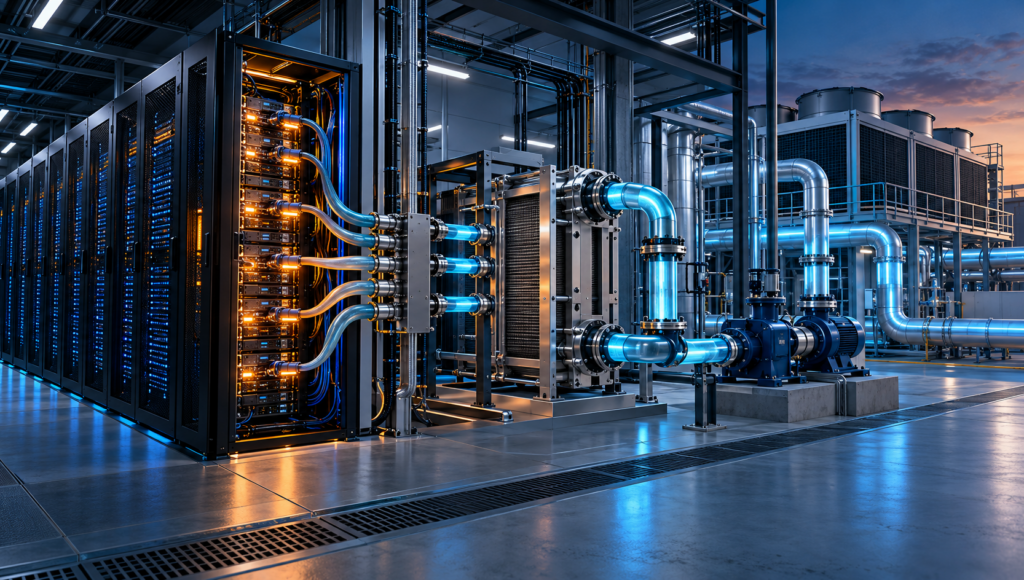
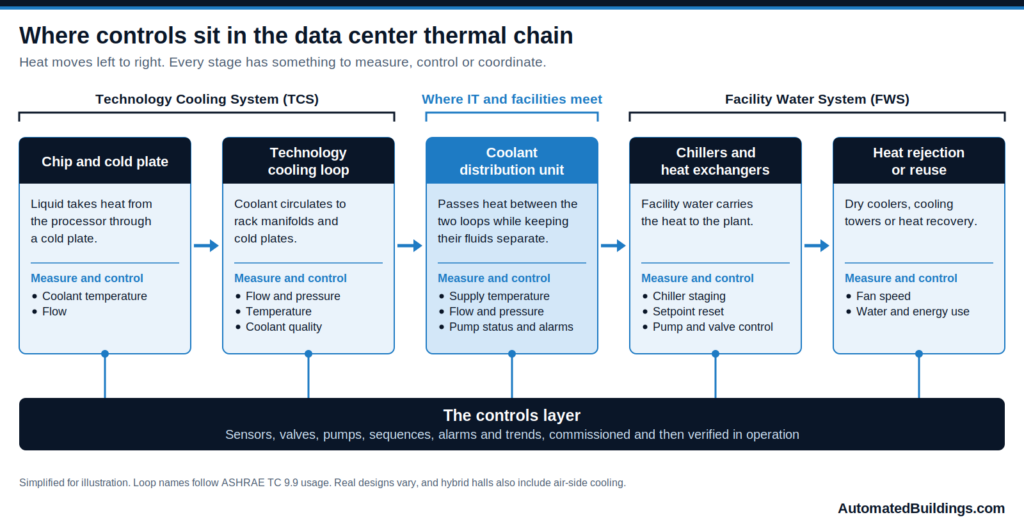
At the chip, heat may enter a liquid loop. From there, it can pass through a coolant distribution unit and heat exchanger to the facility water system and, ultimately, the plant and heat rejection equipment. Air cooling remains essential for many loads, including equipment that is not liquid cooled.
That creates a practical controls problem. The facility must maintain the right temperatures, flow and differential pressure while loads change. It must coordinate pumps, valves, fans and chillers, detect bad readings, and move safely through equipment failures. The sequence has to work in the field, not only on the design drawing.
Uptime Institute cautions that direct liquid cooling remains concentrated in high-density applications. Many operators will run air and liquid cooling side by side. Hybrid systems make the interface between IT equipment and facility operations especially important: who specifies the required conditions, who monitors them, and who responds when they drift?
Existing facilities are part of the opportunity.
Some of the most demanding work will happen in operating data centers. Adding a liquid-cooled zone or replacing controls in a live plant requires a migration plan, tested sequences and commissioning that respects uptime. A RoviSys case study describes a controls upgrade performed in an operational data center without measurable downtime. The example shows why installation skill alone is insufficient; the handover and failure modes have to be understood before a change goes live.
AutomatedBuildings.com has explored the widening boundary between IT and facilities in its liquid-cooling coverage and the need to connect BMS, electrical, and other operating data in mission-critical facilities. The question for this session is what controls teams need to measure, integrate and prove as that boundary moves.
A field conversation at AHR
Scott Cochrane of Cochrane Supply & Engineering will moderate.
The discussion should get specific. Where do air and liquid systems meet in the sequence? What must be tested before a retrofit goes live? Which measurements reveal a cooling problem early? Who owns the response when IT loads change faster than the plant? And what evidence shows a system will keep performing after commissioning?
AI is driving demand, but heat is the physical constraint. This session will examine where controls professionals can help data centers manage it and what they will need to demonstrate in the field.
Data Center Boom: The Opportunity
AHR Expo 2027 Education Session
Hosted by AutomatedBuildings.com
Sources and further reading
- IEA, Key Questions on Energy and AI
- Berkeley Lab, United States Data Center Energy Usage Report: 2025 Update
- Uptime Institute, Liquid cooling will not outgrow its high-density niche
- RoviSys, Upgrading Without Downtime in an Operational Datacenter
- AutomatedBuildings.com, Surfs Up! The Liquid Cooling Mandate
- AutomatedBuildings.com, Why the Single Pane of Glass Matters