Conversation with Gemini
The Inversion of Vulnerability
The initial narrative surrounding artificial intelligence assumed automation would dismantle blue-collar, field-level trades first, leaving white-collar analytical, drafting, and programming roles insulated. In practice, the opposite has occurred. Generative models, predictive analytics, and autonomous code assistants excel at processing abstract, text-heavy, and purely digital tasks—the very bedrock of entry-to-mid-level desk work.
In physical domains like building automation, industrial controls, and smart infrastructure, the dynamic is fundamentally different. AI cannot physically calibrate a differential pressure sensor, feel mechanical vibration in a chiller bearing, trace a shorted RS-485 pair through a packed plenum, or interpret why a valve actuator is binding despite an electrical command to open.
As AI permeates every layer of building and operational technology, practitioners who understand physical systems and real-world dynamics find themselves unexpectedly well-positioned. Rather than facing replacement, they are encountering an inflection point where their domain expertise makes them the indispensable pilots of AI tools.
The Practitioners’ Structural Advantage
Those whose work exists purely inside a screen—compiling routine reports, writing boilerplate code, or interpreting high-level dashboard summaries without physical context—are most exposed to algorithmic substitution. In contrast, operational practitioners hold three structural advantages:
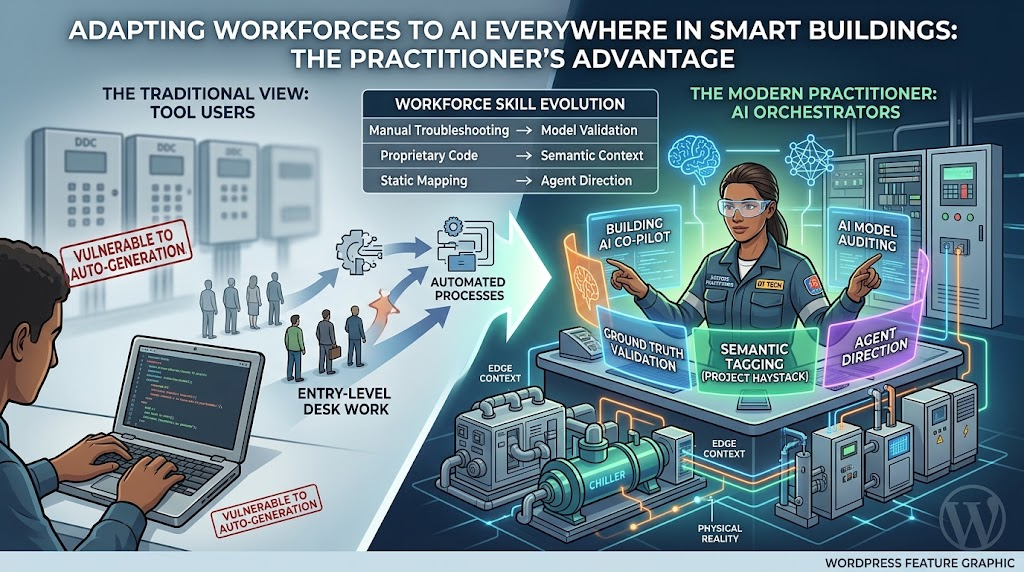
- Ground Truth and “Edge Context”: AI models hallucinate or misdiagnose when they lack physical grounding. A predictive model might flag an anomalous supply temperature as a faulty PID loop, whereas a practitioner on-site immediately identifies a clogged strainer or a stuck bypass damper. Ground truth belongs to those who understand the laws of thermodynamics, mechanics, and fluid dynamics.
- The Translation Layer: AI does not instinctively know what questions to ask a building. It requires human intent to frame constraints, validate edge cases, and define safe operating boundaries. The practitioner acts as the translation layer between complex field assets and abstract machine reasoning.
- Trust and Liability: No building owner or municipal operator will hand life-safety sequences, smoke control, or multi-megawatt chiller plant staging entirely to an unmonitored neural network. The liability, regulatory compliance, and ethical accountability remain tied to certified practitioners who can inspect, verify, and override autonomous logic.
The New Skill Matrix: From Tool Users to AI Orchestrators
Adapting to “AI everywhere” does not require every controls technician or facility engineer to become a machine learning researcher. Instead, it demands an evolution toward becoming an orchestrator of autonomous systems.
  Traditional Skill Base                Evolving AI-Era Core
┌────────────────────────────┐        ┌────────────────────────────┐
│ • Hardwired Troubleshooting│        │ • Model Validation & Audit │
│ • Proprietary Programming  │  ───►  │ • Semantic Context (Graphs)│
│ • Static Point Mapping     │        │ • Prompt & Agent Direction │
│ • Routine Data Logging     │        │ • Edge Compute Operations  │
└────────────────────────────┘        └────────────────────────────┘
1. Semantic Literacy over Proprietary Tagging
The era of memorizing a single manufacturer’s proprietary point naming convention is fading. As autonomous agents query building databases, the critical skill is understanding semantic data modeling—standardizing physical relationships using ontologies like Brick, Project Haystack, or ASHRAE 223P. The modern practitioner must know how to represent the physical world in machine-readable graphs so AI agents can query assets without human intervention.
2. Model Auditing and Sanity Checking
As AI agents begin drafting control sequences, generating BACnet integration scripts, or auto-tuning control loops, the practitioner’s role shifts from author to editor and auditor. The essential skill is spotting edge-case hallucinations:
- Does this proposed reset schedule risk short-cycling the compressor?
- Did the optimization agent violate minimum ventilation standards to artificially depress energy use?
- Can this control sequence handle a sudden sensor failure gracefully?
3. Agentic Workflow Direction
Prompt engineering in physical operations is not about writing prose; it is about defining constraints, operational envelopes, and verification steps. Practitioners must learn to feed AI agents site histories, wiring schematics, sequence manuals, and raw trend logs to perform root-cause analysis, generate punch lists, and draft commissioning documents in minutes rather than days.
4. Edge and IT/OT Infrastructure Literacy
Because real-time building control cannot tolerate latency or cloud connectivity drops, AI is moving directly to the local edge. Practitioners must be comfortable navigating containerized microservices (such as Docker on edge gateways), local Linux environments, and zero-trust cybersecurity protocols (like BACnet/SC). The line between the operational technician and the network edge admin has permanently blurred.
The Cultural Shift: Empowerment vs. Displacement
The workforce divide will not be between humans and AI; it will be between practitioners who leverage AI and practitioners who ignore it.
Those who view building automation strictly as manual wire-pulling and point-to-point checkouts will find their time-consuming tasks automated away by auto-commissioning tools and auto-tagging algorithms. But those who lean into the technology—using LLMs to dissect complex vendor documentation, employing vision tools to catalog panel components, and using predictive models to diagnose chronic comfort issues—will multiply their output.
By combining tactile intuition with computational leverage, the hands-on practitioner evolves from a field technician into an operational systems architect—the one person in the room whom the algorithm cannot replace.