The Great Generational Handoff: Passing Intuition to the Digital Natives
The building automation and controls industry stands at an unprecedented demographic and technological crossroads. A generation of practitioners who built the industry from brass pneumatic restrictors and early Direct Digital Control (DDC) mainframes to networked BACnet systems is approaching retirement. At the same time, an incoming cohort of software engineers, data practitioners, and cloud-native thinkers is entering building operations.
Historically, generational transitions were viewed as one-way transfers of legacy field wisdom: teaching newcomers how to calibrate actuators, balance airflow, and read hardwired electrical schematics.
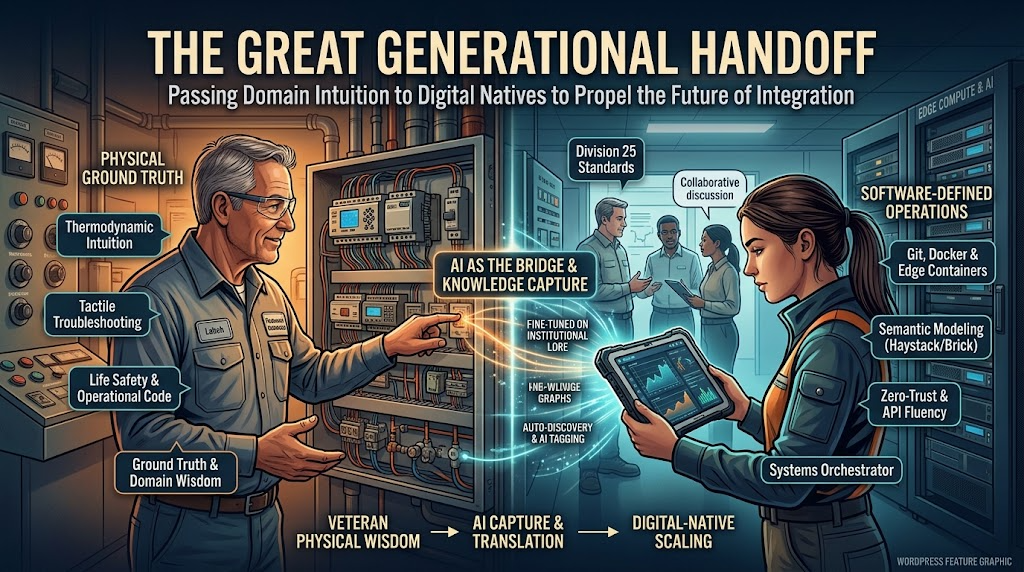
Today, that dynamic has shifted. The generational handoff is not a retirement drawdown; it is a bilateral synthesis. Veteran domain expertise—the physical intuition of thermodynamics, psychrometrics, and mechanical reality—is meeting a new generation equipped with modern computer science primitives. Together, augmented by artificial intelligence, they are redefining the very discipline of systems integration.
1. The Skill Sets of the Incoming Cohort
The emerging workforce approaches buildings not as isolated mechanical plants, but as distributed software environments. Their natural skill set provides the missing capabilities needed to realize the true “Future of Integration”:
- Software-Defined Thinking (Git, Containers, & CI/CD): Where traditional building management treated control logic as a static panel program flashed once and forgotten, incoming practitioners bring modern DevOps practices. They manage control strategies as code—version-controlled in Git repositories, containerized via microservices (Docker) at the edge, and deployed through automated continuous integration pipelines.
- Semantic Native Instincts: The new generation does not think in proprietary register numbers or flat point lists (
AHU_SF_SPD). Having grown up with web standards, relational databases, and modern APIs, they intuitively grasp knowledge graphs. They adopt semantic models like ASHRAE Standard 223P, Project Haystack, and Brick not as extra paperwork, but as the foundational digital schema required for any system to scale. - API & IT-OT Fluency: Instead of being intimidated by IT network policies, modern integrators navigate zero-trust security, PKI certificates, BACnet/SC routing, and REST/GraphQL/MQTT endpoints with the same comfort previous generations brought to multimeters and wire strippers.
2. Why the Handoff Requires Veteran “Ground Truth”
Software fluency alone cannot run a central utility plant. Without physical grounding, digital-native abstractions easily produce costly, dangerous errors:
- Thermodynamic Reality vs. Mathematical Optimization: An algorithmic model might identify a mathematical optimization that continuously modulates a chilled-water valve or ramps a fan up and down every 45 seconds to track a dynamic setpoint. The veteran technician knows that doing so will destroy the mechanical packing of the valve or burn out an actuator within six months.
- Sensor Drift and Plenums: A software engineer sees an anomalous temperature reading and assumes an algorithm bug or an out-of-spec room. The veteran recognizes the signature of a drifted thermistor, stratified air across a mixed-air plenum, or a clogged chilled-water strainer.
- Operational Accountability & Life Safety: You cannot “roll back a build” if a freeze-stat trips, a coil bursts, or a smoke evacuation damper fails to actuate. The veteran generation brings the non-negotiable culture of life-safety, code compliance, and physical accountability that software development culture historically takes for granted.
3. AI as the Generational Bridge and Knowledge Capture Engine
Artificial intelligence is not displacing this workforce; it is the catalyst that makes the handoff possible before the veteran knowledge base retires:
- Digitizing Decades of Tacit Knowledge: Much of the world’s operational building intelligence is unwritten—locked in the mental heuristics of senior technicians. AI agents, fine-tuned on legacy equipment manuals, sequence guidelines, and recorded voice notes from senior engineers, serve as an interactive bridge. A junior technician on-site can describe a mechanical hunting issue in plain language, and an AI co-pilot, trained on that institutional lore, can suggest the exact physical inspection steps the veteran would have performed.
- Accelerating Time-to-Competence: Historically, mastering BAS took 10 to 15 years in the field. AI-assisted auto-discovery, instant sequence-to-code generation, and automated commissioning tools allow newer practitioners to audit systems and diagnose complex faults in their first two years, standing on the shoulders of the prior generation’s lessons.
- The Orchestration Partnership: As discussed in our previous look at the practitioner’s advantage, the combination of veteran intuition and modern tools creates an unassailable operational role:
- The digital native directs the AI agents, builds the semantic data pipelines, and oversees edge containers.
- The veteran practitioner audits the AI outputs, defines the operational safety envelope, and validates physical ground truth.
4. Propelling the Future of Integration
When these two worldviews merge, integration evolves beyond the routine service call:
- Autonomous Edge Orchestration: Integration becomes a continuous, living software deployment. Systems dynamically respond to real-time grid conditions, dynamic energy pricing, and microgrid variables because the data models and the physical loops are equally sound.
- Living Specifications: Division 25 is no longer just static boilerplate specification text; it becomes an active governance model that young engineers enforce via automated schema validators, ensuring that building owners truly own their data and control logic from day one.
- A Culture of Mentorship: Rather than fearing obsolescence, the senior generation steps into the role of high-level systems mentor and model auditor, while the junior generation acts as the computational engine translating physical instincts into scalable, open digital architectures.
The future of integration does not belong to pure programmers or traditional field mechanics. It belongs to the hybrid team—where generational wisdom provides the compass, software fluency provides the vehicle, and AI provides the engine.