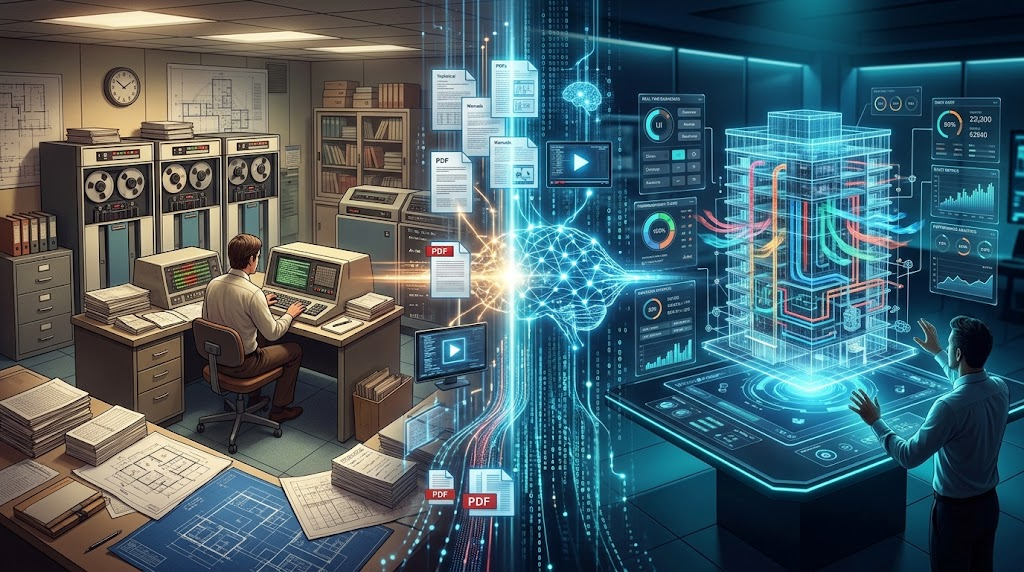
The shift from static documentation—paper punch cards decades ago, and static PDFs, manuals, and instructional videos today—into dynamic, AI-driven simulations represents a fundamental evolution in how we understand complex systems.
When engineers first queued decks of 80-column punch cards into mainframes running early DOE-2 or BLAST engines, the true breakthrough wasn’t just getting an energy number out at the end. It was the forced discipline of understanding the building as an interactive, thermodynamic system. You had to conceptualize how thermal mass, solar heat gain, occupancy schedules, and mechanical loops influenced one another over time.
Today, turning flat cut-sheets, sequence of operations (SOO) documents, and equipment webinars into living, generative simulators offers that exact same paradigm shift—only orders of magnitude faster and more interconnected.
1. Moving Beyond the “Flat Document” Bottleneck
For decades, building systems, industrial automation, and connected IoT products have suffered from a disconnect between design intent and operational reality:
- PDFs and Sequences are Static: A manufacturer’s sequence manual describes steady-state operations or idealized conditions. It cannot show an operator what happens when a chilled water valve sticks at 40% open while an economizer damper hunts on a humid 22°C morning.
- Video Content is Passive: A webinar or walk-through demonstrates a single happy path. It cannot be prodded, stressed, or driven into failure modes.
- Context Extraction via AI: Large multimodal models can ingest hundreds of equipment manuals, wiring schematics, and sensor registers simultaneously, establishing relationships between disparate sub-systems (HVAC, lighting, metering, power quality) that human engineers rarely have time to cross-reference manually.
2. The Core Value Drivers of Interactive Simulators
Accelerated Mental Models and System Intuition
Just as punch-card batch runs forced engineers to develop an intuitive grasp of thermal dynamics, interactive simulation creates an immediate feedback loop:
- Cause-and-Effect Exploration: Integrators and technicians can manipulate setpoints, simulate seasonal drift, inject network latency into field-bus loops, and visually observe cascaded failures across upstream and downstream equipment.
- Bridging Domain Gaps: IT personnel, facility operators, and sustainability directors rarely speak the same language. An interactive simulation serves as a shared visual canvas where an IT specialist sees network behavior and a mechanical tech sees fluid dynamics simultaneously.
De-Risking Integration Before Truck Rolls
Physical commissioning on job sites is notoriously expensive and prone to finger-pointing between vendors:
- Software-in-the-Loop Testing: Simulators allow teams to test supervisory logic, API integrations, and edge controllers against virtual equipment models before physical installation.
- Failure-State Validation: You cannot safely test what happens during an emergency power transfer or high-head-pressure trip on live, multi-million-dollar chillers or life-safety gear. In a simulator generated from vendor manuals, you can stress-test edge conditions safely.
Sales, Specifying, and “Show, Don’t Tell” Value
From a commercial perspective, marketing connected products via static brochures is losing its efficacy:
- Living Product Demonstrations: Letting a prospective client or specifying engineer toggle ambient conditions, grid signals, or tenant densities inside a simulated web sandbox immediately proves the value of adaptive algorithms and smart hardware.
- Proof of Interoperability: Demonstrating how product A talks via open standards to product B inside a live digital environment eliminates the primary objection in smart infrastructure: fear of proprietary lock-in.
3. The Generative Shift: How AI Bridges the Manual Gap
In the past, building a simulation (a physics-based digital twin) required months of manual coding, mathematical modeling, and proprietary simulation software.
The current inflection point is that AI automates the translation layer:
- Semantic Extraction: Multimodal AI reads tabular performance curves, control flowcharts, and technical text from manufacturer PDFs, converting them into standardized logic blocks (e.g., Python models, state machines, or Haystack/Brick-tagged data flows).
- Synthetic Telemetry Generation: Instead of needing years of logged operational data to train a model, generative engines can produce realistic, noisy sensor streams that mimic actual operational behavior under variable conditions.
- Continuous Self-Tuning: As field telemetry becomes available, the simulator refines its internal assumptions, evolving from an idealized manual representation into a high-fidelity mirror of real-world operations.
The transition from punch cards to digital modeling taught the industry how to design buildings for energy performance; transforming the static manuals and media of today into AI-driven simulators will teach the next generation how to run interconnected systems autonomously.