
How could we turn autonomous into value?
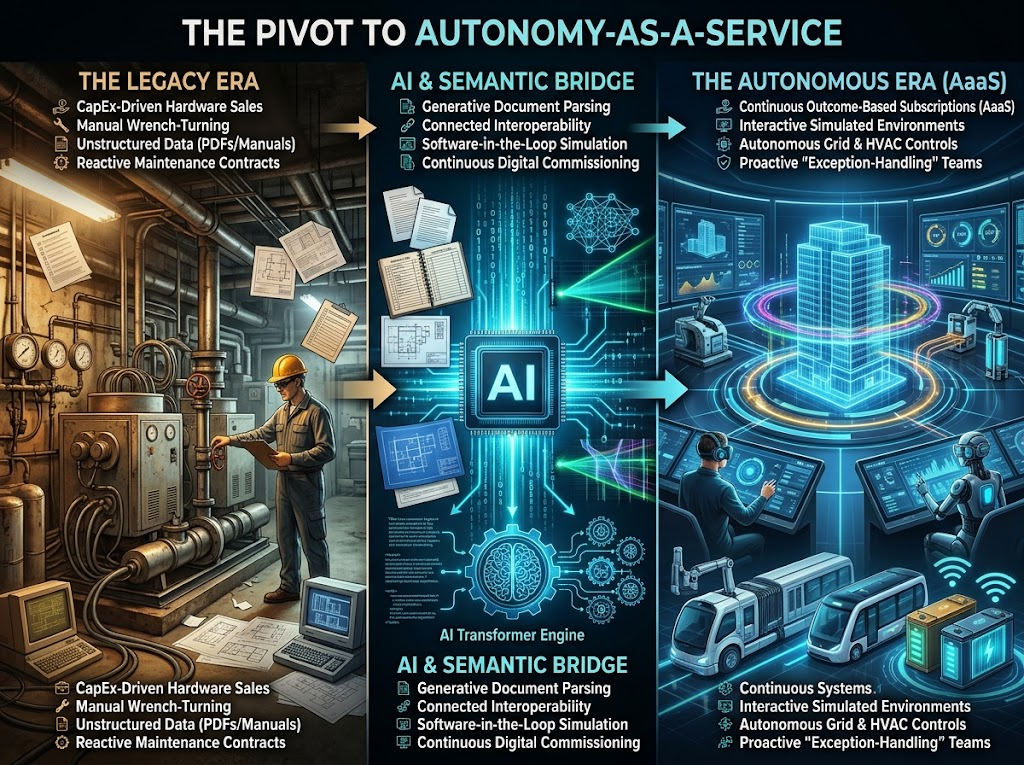
The transition underway across building automation, industrial infrastructure, and technical services reflects an operational and commercial shift: turning legacy hardware, unstructured technical documentation, and manual expertise into dynamic simulations and recurring Autonomy-as-a-Service (AaaS) revenue streams.
Key Themes & Strategic Shifts
- Monetizing AI Beyond Cost-Cutting: The market has pivoted from using software merely to shave labor hours to creating active profit centers. Organizations are structuring dormant data, field telemetry, and decades of domain knowledge into proprietary agents, performance-guaranteed contracts, and grid-interactive services (such as virtual power plants and dynamic peak shaving).
- The Evolution of Systems Simulation: Just as the transition from 80-column paper punch cards to computerized energy modeling once forced engineers to grasp thermodynamic interactions dynamically, multimodal AI is driving a parallel shift today. By ingesting static PDFs, sequences of operation, equipment manuals, and video walk-throughs, AI generates interactive, real-time simulators. These virtual environments de-risk multi-vendor integration, enable software-in-the-loop stress testing, and prove out open-standard interoperability before physical deployment.
- Five Practical Pillars of Building Autonomy: Rather than treating autonomy as an abstract concept, five focused application areas illustrate its real-world trajectory:
- Horizontal & Vertical Mobility: The complete transition from manual elevator attendants to sensor-driven, occupancy-aware destination dispatching and predictive servicing.
- Indoor Environmental Control: Central chiller plants and mechanical loops evolving from rigid schedules to self-optimizing supervisory agents responsive to dynamic utility rates.
- Automated Sanitation: Autonomous cleaning and facade robotics transitioning janitorial teams into high-leverage fleet supervisors.
- Safety & Access Integration: Perimeter security and life-safety systems moving from static desk patrols to optical AI surveillance and automated emergency routing.
- Autonomous Resource Management: Smart behind-the-meter microgrids, battery storage, and waste streams actively transacting with utility networks.
- The Channel Pivot to Autonomy-as-a-Service (AaaS): Systems integrators and mechanical contractors are moving away from cyclical, low-margin “bid-and-spec” hardware sales toward multi-year subscription models. By pairing open semantic ontologies (e.g., Project Haystack, ASHRAE Standard 223P / Brick) with edge compute overlays, vendors can continuously commission and optimize mixed-vintage portfolios. This transitions field labor from reactive “wrench turners” to remote “exception handlers,” dramatically expanding gross margins and elevating contractor business valuations.
The Paradigm Shift at a Glance
| Strategic Dimension | Legacy Operational Model | Autonomous / Generative Model |
|---|---|---|
| Technical Knowledge | Static manuals, cut-sheets, fixed code, and punch-card batches | Generative, interactive digital twins and state-machine simulators |
| Primary Revenue Driver | One-time equipment markup, installation labor, and billable hours | Predictable Annual Recurring Revenue (ARR) via AaaS subscription tiers |
| Operational Logic | Reactive truck rolls and periodic preventative maintenance | Continuous digital commissioning, predictive SLAs, and closed-loop optimization |
| System Interoperability | Siloed, proprietary field buses and vendor lock-in | Standardized open semantic models, edge intelligence, and grid interactivity |
Want more information?https://www.automatedbuildings.com/author/ksinclair/