
Yesterday’s MondayLive chat featured Duncan from the UK, who explained why he was excited as a young practitioner about the industry; part of that excitement was the empowerment he felt in his craft.
I ported this discussion over to Gemini, and it suggested rebranding his position to Cyber-Physical Engineer
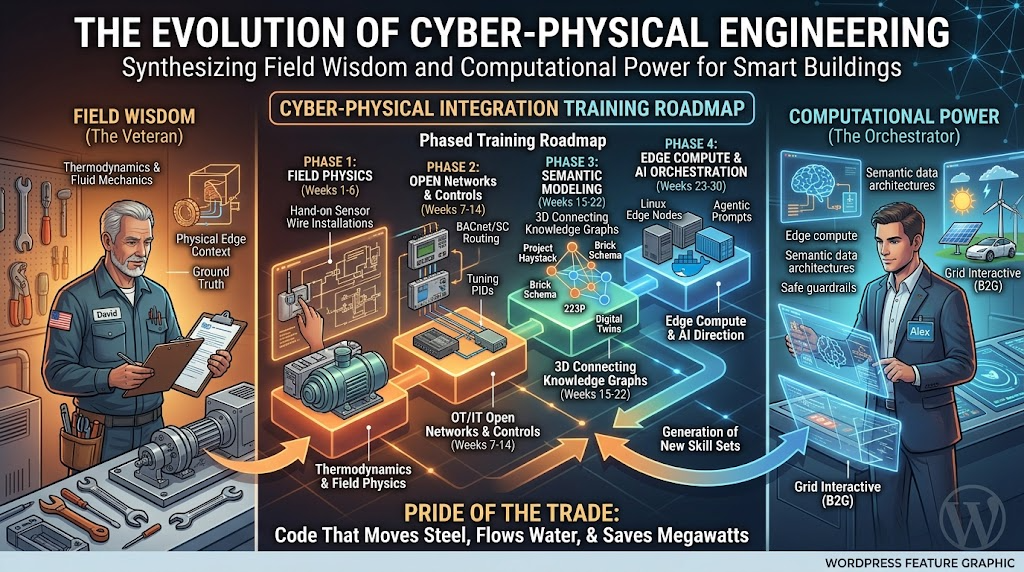
Beyond the “Handoff”: The Synthesis of Field Wisdom and Computational Power
The smart building industry has spent years obsessing over a looming generational “handoff”—a narrative framed around older technicians retiring, handing over their keys, and hoping a younger generation will step into identical boots. That mental model is flawed.
The future of integration is not a baton pass of legacy tasks; it is a synthesis of generational skill sets. It is the collision of hard-earned thermodynamic intuition and physical troubleshooting with cloud-native architectures, semantic graphs, and physical AI.
When you frame integration as a mechanical handoff, you ask newcomers to inherit legacy friction: manual register mapping, proprietary programming cables, and tedious point-to-point checkouts. When you frame it as the creation of an entirely new hybrid trade—the cyber-physical systems architect—you change the value proposition entirely. The veteran field practitioner provides the ground truth, physical laws, and operational intuition that keep buildings safe and stable, while the emerging practitioner brings the computational leverage to scale that wisdom across thousands of assets.Redefining the Pride of the Trade
To attract emerging engineers, coders, and makers, the industry must re-anchor where professional pride comes from. For decades, pride meant mastering a single proprietary controller line or building a flashy graphic page. In an era saturated with disembodied software, the pride of the modern practitioner is far more compelling: commanding physical reality through digital intelligence.
How to Attract New Practitioners: The Playbook
Recruiting the next generation requires meeting them where their curiosities and values lie, rather than advertising entry-level trade apprenticeships using twentieth-century language.
- Rebrand the Role as Cyber-Physical Engineering: Stop advertising for “DDC Technicians” or “Low-Voltage Cable Installers.” Recruit for Smart Building Systems Architects, Edge Compute Engineers, and OT Data Integrators.
- Lead with Hands-On Maker Labs: High schools, vocational colleges, and universities are filled with students tinkering with microcontrollers, Home Assistant, Python scripts, and robotics. Show them how their home-lab hobbies scale directly into commercial skyscrapers, hospitals, and university campuses.
- Showcase the Modern Toolkit: Demonstrate the work using modern tools: terminal windows, Git repositories, semantic visualizers, and edge appliances alongside multimeters and diagnostic gauges. Show them that this trade blends software craftsmanship with physical engineering.
- Highlight Direct Climate and Energy Stewardship: For mission-driven candidates, building operations account for a massive share of global carbon emissions. Position integration as the ultimate practical weapon against climate change: decarbonization cannot happen on a PowerPoint slide; it happens at the valve, the chiller, the inverter, and the edge gateway.
When newcomers see that this profession gives them the power to breathe intelligence into the built environment—grounded in real physics and scaled with cutting-edge software—the role ceases to be a job. It becomes a craft they can take immense pride in mastering.