
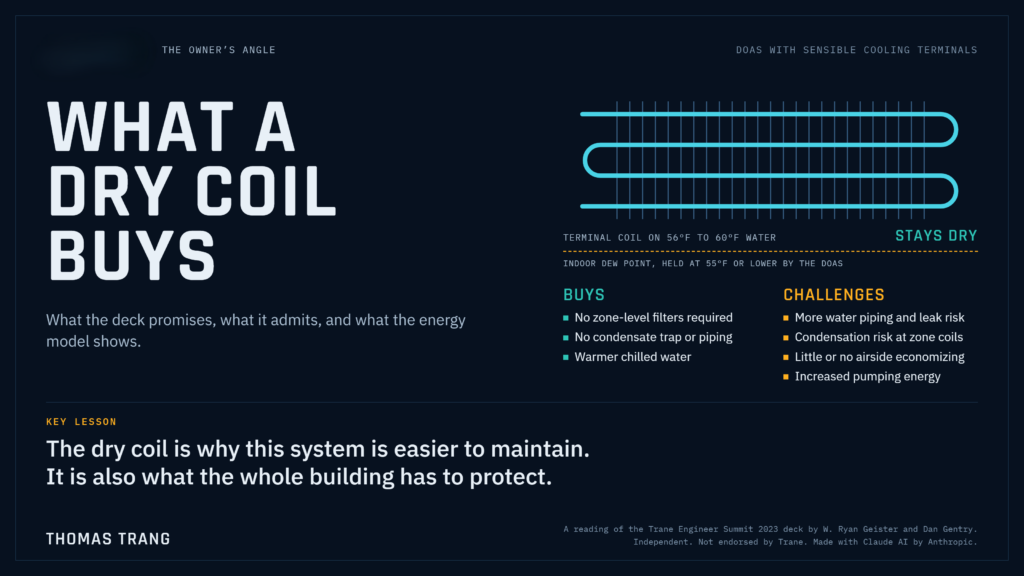
The owner’s angle. What the deck promises, what it admits, and what the energy model shows.
An owner or facility manager lives with the ceiling, the maintenance route, and the utility bill. I read the deck a third time with those in mind.
What the deck promises
The summary slide sorts the benefits into four groups.
- Efficiency. ECM terminal fan motors, sensible cooling with warmer water, and zone-level DCV built in.
- Comfort. Independent zone temperature control and active zone humidity control.
- Low maintenance. No zone-level filters required. No zone-level drain pan, condensate trap or piping.
- Flexibility. Hot water or electric heat, small air handlers and ductwork, boost mode as a risk mitigation option for the designer, and easy reconfiguration when space use changes.
The maintenance claims rest on one fact. The terminal coil is meant to run dry. ASHRAE 62.1-2016 section 5.8 asks for MERV 8 filtration upstream of wetted cooling coils. The deck points to the exception for coils designed, controlled and operated for sensible cooling only. Its backup slide is titled “A Filter is Not Required, but may Still Be Desired.”
One detail to square before a walkthrough. The summary slide says no zone-level drain pan. Another slide lists a drip pan and optional filter as an advantage over chilled beams, and the condensate detection slide shows a moisture sensor in a drip pan. I read that as a drip pan with a sensor and no trap or piping. I would ask.
Against chilled beams
The deck’s comparison with active chilled beams lists seven advantages:
- Typically smaller ductwork and a smaller air handler
- Fewer terminal units per zone
- Easier to implement DCV
- Factory-mounted, pre-engineered controls
- A drip pan and an optional filter
- Easier to reconfigure when space usage changes
- Unoccupied heating or cooling without the central fan
Against VAV, with the challenges
The VAV slide is the most useful one for an owner because it has a challenges column. It runs traits of both systems together, so it takes some sorting. I read these four as belonging to the sensible cooling system:
- More water piping and more risk of leaks
- Risk of condensation at zone cooling coils
- Little or no airside economizing
- Increased pumping energy
That sorting is my reading. The slide does not label which system each line describes.
What the energy model shows
The deck models a 268,000 square foot office in four cities. It compares three systems: active chilled beams, sensible cooling with DOAS, and high-performance VAV. The numbers are percent reductions in annual HVAC energy against the chilled beam system.
| City | Sensible cooling with DOAS | High-performance VAV |
| Atlanta | 15% | 9% |
| Los Angeles | 21% | 29% |
| Minneapolis | 6% | 12% |
| Washington D.C. | 13% | 13% |
Sensible cooling with DOAS beats the chilled beam system in all four cities. Against high-performance VAV it wins in Atlanta, ties in Washington D.C. and trails in Los Angeles and Minneapolis. The source is TRACE 700 output dated October 2017. It is one building and one set of assumptions.
Where the owner’s decisions land
Three line items in this system change how it operates.
- The zone humidity sensor. Two of the three levels of condensation prevention need it.
- The DOAS configuration. It sets duct insulation needs, terminal size and DOAS fan energy.
- The plant. The system needs two water temperatures. The deck shows several ways to make them, including ice storage.
Questions I would bring to the meeting
- Which DOAS configuration is proposed, and what supply air temperature does it deliver?
- Is there a humidity sensor in every zone?
- What is under the terminal coil, and where does water go if the moisture sensor trips?
- Was the energy comparison run for this building and this climate?
- Who gets the call when a zone reports “blowing but not cooling”?
What I take from it
The dry coil is the reason this system is easier to maintain. It is also what the whole building has to protect. An owner who understands that can ask better questions of the designer and the operator.
Source: W. Ryan Geister and Dan Gentry, “Today’s Challenges Impact System Design Choices,” Trane Engineer Summit 2023. This is my reading of one presentation. It is not Trane guidance and Trane has not reviewed it. Energy figures are the deck’s, from one modeled building. Verify against current manufacturer documentation and the engineer of record. Drafted with Claude AI by Anthropic.
Simulators:
DOAS-01BAS Training Series · Operator console
Sensible Cooling Terminal and DOAS Trainer
DOAS-02BAS Training Series · Operable reader