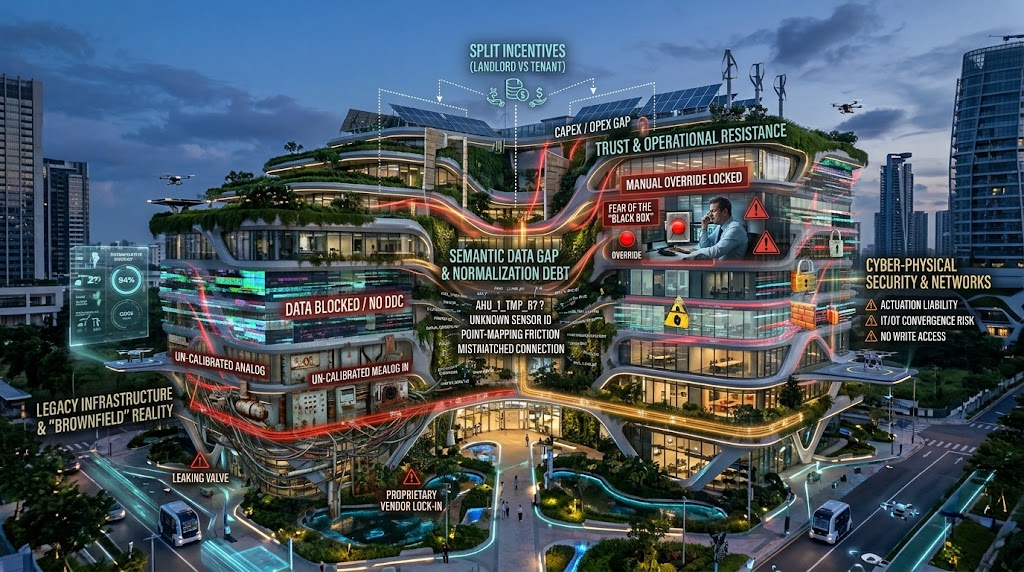
The barriers preventing buildings from transitioning from automated or “smart” to truly autonomous are rarely about the availability of machine learning algorithms. Instead, they stem from deep-seated structural, technical, legal, and operational realities across the built environment.
1. Legacy Infrastructure and the “Brownfield” Reality
- Fragmented, Proprietary Protocols: Most commercial stock runs on a patchwork of legacy field buses, proprietary vendor communication layers, and non-standardized network topologies. Exposing these systems to autonomous closed-loop control without breaking existing sequences of operation is difficult and expensive.
- Low-Fidelity Mechanical Systems: Software can only be as effective as the physical machinery it controls. Leaking pneumatic actuators, rusted damper linkages, uncalibrated analog sensors, and manual balance valves cannot execute micro-adjustments or dynamic setpoints commanded by an AI model.
- Lack of Direct Digital Control (DDC) Granularity: Centralized plants often feed monolithic zones lacking variable airflow or localized reheat capabilities, limiting the physical capacity to act on granular, zone-level autonomous decisions.
2. Semantic Data Gaps and Normalization Debt
- Point-Mapping Friction: Autonomous engines require structured, context-rich metadata: what a sensor measures, its engineering units, what equipment it serves, and its downstream thermal relationships. In practice, building points are still frequently labeled with arbitrary text strings (e.g.,
AHU_1_TMP_R), requiring tedious, error-prone manual mapping. - Slow Adoption of Semantic Standards: While frameworks like Project Haystack, Brick Schema, and ASHRAE 223P solve the semantic problem conceptually, widespread native controller-level adoption remains slow. Without standardized digital twins, every building requires bespoke onboarding, eliminating economies of scale.
3. Split Incentives and Misaligned Contracts
- The Landlord-Tenant Dilemma: In commercial triple-net (NNN) leases, capital investments in autonomous optimization fall on the property owner, while the utility savings accrue entirely to the tenant. Owners lack direct financial motivation to invest in deep autonomy unless it directly impacts leasing rates or asset valuation.
- Service Contract Models: Traditional HVAC and controls maintenance contracts are structured around fixed-rate preventive maintenance (truck rolls, visual checks) rather than continuous algorithmic performance tuning. Transitioning to software-led operations disrupts existing business models for systems integrators and mechanical contractors.
4. Operational Trust, Cultural Resistance, and the “Operator Gap”
- Fear of the “Black Box”: Building operators and facility engineers bear the brunt of complaints when spaces get uncomfortable. If an autonomous system changes a setpoint or stages a chiller through a non-intuitive machine learning algorithm, the operator’s natural instinct is to lock the system into manual override.
- Loss of Override Control: Without explicit, human-interpretable explanations (Explainable AI) detailing why an action was taken (e.g., “Pre-cooling Zone 3 to avoid peak demand pricing at 2:00 PM”), operators will bypass autonomy to protect baseline comfort.
- Workforce Skills Mismatch: The controls workforce is currently split between legacy mechanical/pneumatic technicians and cloud software engineers, with a severe shortage of practitioners who understand both thermodynamic physical loops and modern data engineering.
5. Cyber-Physical Security and Network Boundaries
- IT/OT Convergence Risks: Traditional Building Management Systems (BMS) were historically isolated via “air gaps.” Autonomous supervisory engines require outbound telemetry to the cloud or edge gateways, introducing attack surfaces into critical physical infrastructure.
- Actuation Liability: Read-only analytics (dashboards, anomaly detection) carry low operational risk. In contrast, autonomous closed-loop actuation—where an external software service writes setpoints back to physical equipment—triggers strict IT security pushback, risk-management reviews, and complex firewall hurdles.
- Lack of Zero-Trust Frameworks: Legacy OT field protocols (like standard MS/TP or older BACnet/IP) lack native encryption, token-based authentication, and granular role-based access control, making secure, decoupled actuation difficult without full upgrades to BACnet/SC or modern edge topologies.
6. Legal, Insurance, and Liability Frameworks
- Unclear Fault Attribution: If an autonomous supervisory agent optimizes cooling tower temperatures to save energy, leading to unintentional moisture condensation and mold growth, or causing a data closet to trip offline, liability lines are blurred: Does fault lie with the software vendor, the controls contractor, the facility manager, or the building owner?
- Code and Life Safety Boundaries: Strict regulatory building codes (ASHRAE 62.1 for ventilation, NFPA for fire/smoke dampers) mandate rigid operational baselines. Dynamic autonomous systems that actively throttle airflow must operate within narrow compliance guardrails to avoid violating health and life-safety codes.
Summary of the Impasse
| Dimension | Where the Industry Is | The Barrier to Full Autonomy |
|---|---|---|
| Control Logic | Static schedules & basic PID loops | Closed-loop write access requires deep operational trust and strict fail-safes. |
| Data Layer | Unstructured tags & raw point addresses | Lack of universal semantic ontologies (Brick/223P) at the controller edge. |
| Cybersecurity | Siloed OT or basic firewalls | Moving from passive monitoring to active remote actuation opens physical liability. |
| Financials | Triple-net leases & equipment CAPEX | Disconnected cost/benefit structures between owners, occupants, and utilities. |
| Human Layer | Reactive triage & manual overrides | Skepticism of black-box logic without explainable rationale and simple overrides. |
Which of these friction points—such as the transition from read-only analytics to closed-loop actuation, or bridging semantic modeling down to legacy controllers—presents the steepest hurdle in your work?