Splitting building autonomy across multiple stakeholders—base building landlords, anchor tenants, retail operators, facility managers, and energy service providers—creates friction over control, data liability, and cost allocation. When everyone has skin in the game but nobody owns the full stack, monolithic supervisory systems fail.
Componentizing autonomous capabilities into modular, decoupled micro-services directly addresses this operational tug-of-war.
Why Shared Ownership Stalls Autonomy
- Conflicting Objectives: Landlords aim to maximize asset value and minimize bulk energy spend; commercial tenants demand hyper-tailored thermal comfort and strict indoor air quality (IAQ); utilities demand peak load curtailment.
- Liability & Control Boundaries: If an autonomous agent alters central chiller water temperatures to save energy and a tenant’s server closet overheats, who pays?
- Split Incentive Dilemma: Capital expenditures for efficiency often fall on the building owner, while operational savings accrue to tenants under standard triple-net (NNN) leases.
- Data Sovereignty: Tenants refuse to expose internal occupancy patterns or operational hours to central landlord platforms due to privacy and corporate security concerns.
Componentizing Autonomous Functions: The Architectural Solution
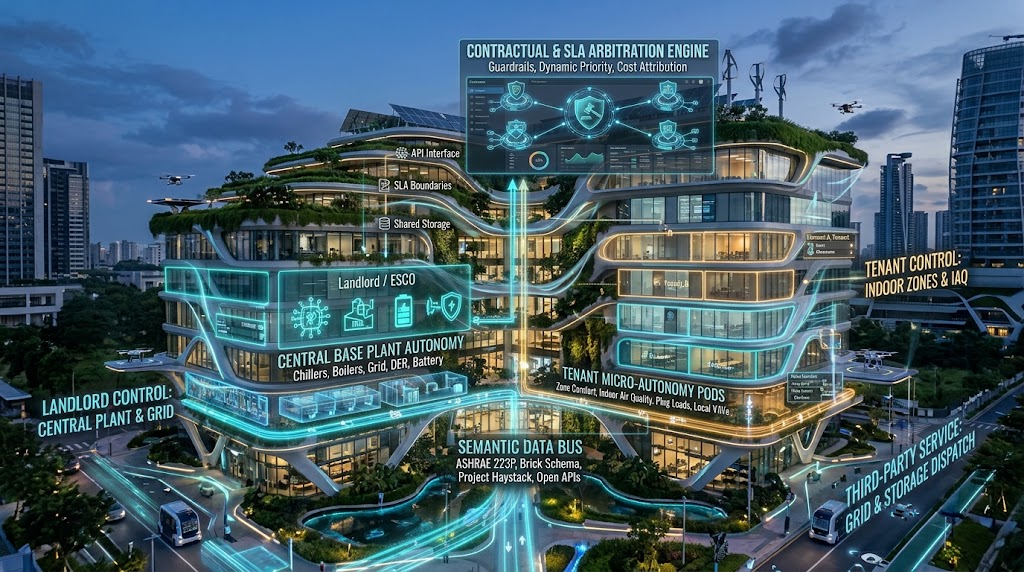
Componentization shifts the building from a centralized “black box” to a federated, service-oriented architecture (SOA). Autonomy is divided into distinct, loosely coupled layers and functional pods:
+-------------------------------------------------------------+
|              Contractual & SLA Arbitration Engine           |
|        (Dynamic Priority, Guardrails, Cost Attribution)     |
+-------------------------------------------------------------+
                               |
       +-----------------------+-----------------------+
       |                                               |
+--------------+                               +---------------+
| Central Base |                               | Tenant Micro- |
| Autonomy Pod |                               | Autonomy Pods |
| (Central     |                               | (Zone Comfort,|
|  Plant, DER) |                               |  Plug Loads)  |
+--------------+                               +---------------+
       |                                               |
+-------------------------------------------------------------+
|               Semantic Data Bus (Open APIs)                 |
|       (ASHRAE 223P / Brick Schema / Haystack / BACnet/SC)    |
+-------------------------------------------------------------+
1. Decoupled Autonomy Tiers (Plant vs. Zone vs. Grid)
- Base Plant Autonomy: Responsible solely for macroscopic plant optimization (chiller/boiler staging, hydronic loop differential pressure, cooling tower fan sequencing). The landlord or energy service company (ESCO) owns this agent.
- Zone-Level Micro-Autonomy: Deployed at the tenant VAV or VRF level. Tenants run their own local optimization policies (e.g., dynamic setbacks, IAQ-first scheduling) within strict boundary envelopes.
- Grid-Interactive Pod: An independent interface handling automated demand response (ADR) and microgrid integration, arbitrating between central battery/solar assets and tenant curtailment bids.
2. Standardized Interface Contracts (Semantic APIs)
Componentization only works if every module speaks the same contextual language:
- Ground the data layer in open semantic standards (ASHRAE 223P, Brick Schema, or Project Haystack).
- Instead of exposing raw I/O registers to third-party algorithms, expose Semantic Service Contracts. For example, a tenant micro-agent does not command a base-building damper directly; it publishes an authenticated demand request:
RequestAirflow(Zone_4B, 450 CFM, Priority_Level_3).
3. Guardrail & Arbitration Middleware
- An autonomous arbitration engine enforces physical and contractual guardrails.
- If a tenant’s autonomy engine requests full cooling while the landlord’s grid agent is fulfilling a mandatory shedding event, the arbitrator evaluates the pre-agreed rules of engagement (e.g., tenant pays a dynamic surge rate to override, or base building caps airflow to a negotiated baseline).
Governance & Business Model Solutions
1. Autonomy-as-a-Service (AaaS) with Outcome-Based SLAs
- Rather than selling software licenses to multiple parties, a third-party autonomous operator delivers guaranteed operational envelopes (e.g., maintaining ASHRAE Standard 55 comfort bands + sub-800 ppm CO₂ for 98% of occupied hours) for a baseline fee.
- Shared financial benefits (such as demand charge reductions or carbon offset credits) are split algorithmically according to verified baseline models.
2. “Digital Leases” and Dynamic Service Level Agreements
- Lease agreements must evolve from static utility allocations to machine-readable Digital SLAs.
- The lease explicitly encodes:
- Minimum/maximum thermal and ventilation bounds.
- Over-consumption penalties or dynamic energy pricing passed through in near real time.
- Override allowances and arbitration priority rankings.
3. Data Escrows and Zero-Knowledge Proofs for Occupancy
- To address tenant privacy, tenant spaces publish aggregated, anonymized metrics to the building bus (e.g., “Zone occupancy tier: Medium” rather than precise person-counts or camera streams).
- Edge controllers process sensitive data locally, only passing necessary load demand vectors up to the base building’s central optimizer.
Implementation Matrix
| Autonomous Component | Responsible Stakeholder | Primary Objective | Interface / Protocol |
|---|---|---|---|
| Central Plant Optimization | Landlord / Base Building Asset Manager | COP maximization, mechanical health, lift reduction | BACnet/SC, ASHRAE 223P model, REST/MQTT |
| Zone Comfort & IAQ | Tenant / Sub-tenant | Occupant productivity, acoustic and thermal comfort | Open APIs, localized edge controllers |
| Microgrid & Storage Dispatch | ESCO / Aggregator / Landlord | Peak shaving, time-of-use arbitrage, battery lifecycle | OpenADR 2.0b / 3.0, IEEE 2030.5 |
| Arbitration & Billing Engine | Neutral Supervisory Platform | Fair cost allocation, SLA audit trails, override dispute | Semantic event logs, tenant portal APIs |