
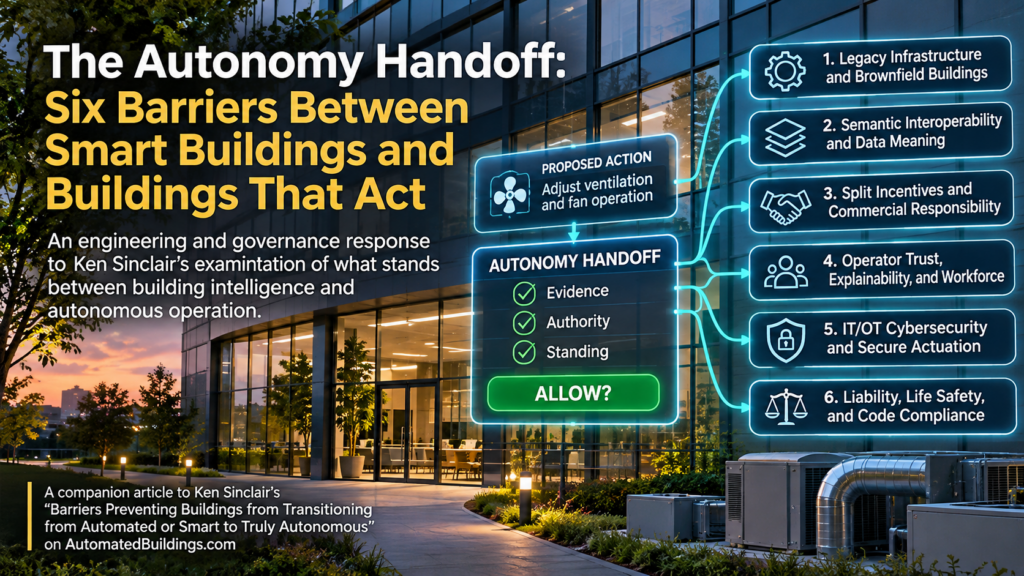
An engineering and governance response to Ken Sinclair’s examination of what stands between building intelligence and autonomous operation.
By Greggory Don Butler
Founder, TA14 Authority Governance Institution
Ken Sinclair Is Asking the Question the Industry Needs to Answer
Ken Sinclair has spent decades helping the building automation industry understand where it has been, where it is going, and what must change along the way.
In his November 2026 AutomatedBuildings.com article, “Barriers Preventing Buildings from Transitioning from Automated or Smart to Truly Autonomous,” Ken identifies six obstacles that stand between today’s intelligent buildings and genuinely autonomous operation.
His examination deserves attention because these are not hypothetical challenges. They exist in the buildings we design, operate, maintain, and attempt to modernize every day.
Read Ken Sinclair’s original article here:
I encourage readers to examine Ken’s article before continuing. His six barriers establish the engineering, commercial, and institutional realities that any credible path toward building autonomy must address.
My purpose here is not to replace his analysis. It is to respond to each barrier and examine what happens when a building moves from recommending an action to physically executing it.
That transition is what I call the autonomy handoff.
Consider one example throughout this discussion.
An AI-enabled building platform recommends reducing outdoor-air intake and adjusting supply-fan operation to save energy during a period of lower occupancy.
The recommendation may be mathematically sound.
But should the building execute it?
Ken’s six barriers help us answer that question.
Barrier 1: Legacy Infrastructure and Brownfield Buildings
The first obstacle is the building itself.
Much of the existing building stock contains equipment installed across different decades, with different control capabilities, maintenance histories, and integration limitations.
A modern analytics platform does not transform an aging actuator into a reliable actuator. Nor does connecting an older air-handling unit to a new supervisory system establish that the equipment can safely perform every requested operation.
In our example, the platform proposes adjusting outdoor-air intake.
Before execution, someone must establish whether the damper operates correctly, whether the airflow measurement is trustworthy, whether the fan can operate within the proposed range, and whether the equipment can preserve necessary ventilation, pressure relationships, and humidity control.
The answer is not to wait until every building becomes new.
It is to establish a verified operating envelope for the equipment that actually exists.
Autonomy should be constrained by demonstrated physical capability, not assumed digital capability.
Where the existing equipment cannot support the proposed action, the answer may be repair, retrofit, restricted operation, or refusal.
That is responsible engineering, not resistance to innovation.
Barrier 2: Semantic Interoperability and Data Meaning
Ken’s second barrier concerns the industry’s longstanding difficulty establishing consistent meaning across building data.
Project Haystack, Brick Schema, and ASHRAE Standard 223 contribute important solutions by helping systems describe equipment, relationships, and data points more consistently.
But identifying a point correctly is not the same as proving its measurement is correct.
Suppose the platform reads an outdoor-air damper position of 35%.
Does that value represent the command issued to the actuator? Actual actuator position? Physical blade position? Or verified outdoor-air delivery?
Those are different facts.
A point can be perfectly mapped and still represent an inaccurate or incomplete physical condition.
This is where semantic interoperability must be accompanied by evidence integrity.
For a consequential intervention, the system needs to know the measurement’s origin, verification status, freshness, continuity, and relevance to the proposed action.
Interoperability tells us what the information means. Admissible Evidence establishes whether that information is sufficient to support the proposed consequence.
The two disciplines complement each other. Neither replaces the other.
Barrier 3: Split Incentives and Commercial Responsibility
Ken’s third barrier is particularly important because even excellent technology can fail when the commercial relationships surrounding it are misaligned.
The owner may pay for automation.
The tenant may experience the indoor environmental consequences.
The mechanical contractor may be responsible for equipment performance.
The platform provider may control the software.
An energy-services company may be compensated for measured savings.
Who benefits from the intervention? Who bears the risk? Who pays when something goes wrong?
And who actually has authority to approve it?
Returning to our example, the AI platform may calculate a legitimate energy-saving opportunity. But the existence of that opportunity does not establish permission to modify the building’s ventilation strategy.
A service contract authorizing monitoring is not necessarily a contract authorizing autonomous control changes.
A contractor’s access credentials do not automatically establish decision-making authority.
And a building owner’s financial interest does not eliminate applicable safety, lease, or operational obligations.
This is why autonomy requires clearly defined decision rights.
The commercial agreements must establish who may authorize which interventions, within what limits, and under what conditions.
TA-14’s Admissible Standing Architecture examines the actor, capacity, standing basis, and authority relationship behind a proposed action.
It does not create contractual rights. It provides a means of examining whether the required authority and standing have actually been established.
Barrier 4: Operator Trust, Explainability, and Workforce Capability
Building operators have good reasons to question autonomous control.
They are responsible for real equipment serving real people.
They understand that an apparently simple setpoint change can interact with occupancy, weather, equipment condition, pressure relationships, and sequences developed over years of operation.
Telling an operator that an AI model is confident is not enough.
Trust requires an understandable explanation of the proposed intervention, the evidence supporting it, its operating boundaries, and the conditions under which it must stop.
In our example, the operator should be able to determine why the ventilation adjustment was proposed, which measurements support it, what constraints apply, and what will happen if the building’s conditions change.
The system should also make disagreement and escalation meaningful.
A human override must not become an undocumented exception that destroys accountability.
Nor should an operator be reduced to approving recommendations without enough information to examine them.
The objective is not to remove human judgment. It is to give human judgment a more reliable evidentiary foundation.
Autonomous systems should reduce repetitive operational burdens while preserving accountable human oversight wherever the consequence requires it.
That demands training, clear operating procedures, and systems designed for examination rather than unquestioning acceptance.
Barrier 5: IT/OT Cybersecurity and Secure Actuation
Ken’s fifth barrier brings the discussion to the point where software can affect physical equipment.
Connecting enterprise information technology with operational technology creates opportunities for optimization, but also expands the consequences of compromised credentials, malicious commands, software defects, and improperly configured permissions.
Strong cybersecurity is indispensable.
Identity management, authentication, segmentation, access controls, secure communications, logging, and resilient control design all matter.
But an authenticated command is not automatically an authorized consequence.
A system may have valid credentials to write a control point while lacking permission to perform a particular intervention under current conditions.
That distinction is central.
In our example, the platform might be technically capable of changing the outdoor-air damper setpoint. Its connection may be encrypted, its identity verified, and its software operating exactly as designed.
Yet the proposed reduction could still be inappropriate because occupancy increased, a sensor became unreliable, or the operating authorization expired.
Secure access establishes who can reach the control system. Consequence-specific authorization establishes whether this particular action is permitted now.
A credible architecture needs both.
The authorization should be bounded by asset, actor, operating conditions, time, and permissible intervention. Material changes should trigger revalidation, suspension, or escalation as appropriate.
Cybersecurity protects the control pathway.
Execution governance examines whether the pathway may legitimately be used for the proposed consequence.
Barrier 6: Liability, Life Safety, and Code Compliance
Ken’s sixth barrier may be the most consequential because autonomous operation cannot escape the physical and legal responsibilities already attached to buildings.
Energy optimization cannot override life-safety requirements.
A control strategy cannot ignore applicable ventilation requirements, equipment protections, or other enforceable obligations merely because an algorithm predicts a favorable outcome.
And when an autonomous intervention produces harm, the industry must be able to reconstruct what occurred.
Consider our ventilation example one final time.
The building executes a permitted adjustment.
Thirty minutes later, occupancy increases unexpectedly. Indoor environmental measurements begin to change. The optimization assumptions no longer match the building’s actual operating conditions.
What happens next?
A responsible system should recognize that the original authorization may no longer be sufficient.
It should evaluate the changed conditions, preserve the relevant records, and take the appropriate permitted response, including reversal or escalation where required.
The record should establish what was proposed, what evidence supported the decision, who or what possessed authority, what was executed, and what the building actually experienced afterward.
That record is important for operations, engineering review, contractual accountability, and any subsequent investigation.
It does not guarantee legal compliance or eliminate liability.
But without a trustworthy record, accountability becomes substantially more difficult.
Autonomy must be able to explain not only why an action was permitted, but what actually happened after the action occurred.
The Handoff: Where Ken’s Six Barriers Converge
Ken’s six barriers are often discussed as separate industry problems.
In practice, they converge at the same moment.
A system proposes a physical intervention.
The equipment must be capable.
The data must be trustworthy.
The commercial and institutional authority must be established.
The operator must have an examinable basis for oversight.
The control pathway must be secure.
The intervention must remain within applicable safety, operational, and legal boundaries.
These are not competing requirements. They are cumulative.
This is where the TA-14 Admissible Execution Architecture contributes a distinct governance function.
Its governing question is:
Does this proposed consequence have sufficient Admissible Evidence, Applicable Authority, and Established Standing to become reality NOW?
The architecture evaluates the proposed consequence and produces a determination: ALLOW, HOLD, DENY, or ESCALATE.
ALLOW means the required conditions for the bounded action have been established.
HOLD means the action cannot proceed until an evidentiary or other resolvable deficiency is addressed.
DENY means a disqualifying condition, such as absent authority, prevents execution.
ESCALATE directs the matter to the appropriate examination or decision-making process.
These determinations do not repair broken dampers, standardize controller metadata, negotiate service agreements, or substitute for cybersecurity and code compliance.
Those responsibilities remain with the appropriate disciplines and authorities.
What the governance architecture adds is a formal examination of whether their outputs collectively justify a particular action at the moment of execution.
And permission is not permanent.
If the relevant evidence, authority, standing, or operating conditions materially change, the system must re-examine whether the proposed or continuing consequence remains permissible.
Which Barrier Is the Steepest?
Ken’s examination raises a particularly useful distinction: is the greater obstacle mapping legacy controller data, or moving from read-only analytics into closed-loop actuation?
Both are difficult.
Legacy integration is a substantial engineering challenge, especially across existing buildings with inconsistent equipment, documentation, and controls.
But my answer is that the transition from read-only intelligence to consequential actuation is the steeper institutional challenge.
Read-only analytics can observe, predict, and recommend without directly changing physical operation.
Closed-loop autonomy crosses a different boundary.
The system is no longer merely describing the building.
It is changing the building.
That change introduces questions of authority, standing, evidence sufficiency, safety, accountability, and continuing permission that cannot be resolved by data mapping alone.
This does not diminish the importance of interoperability. Without it, reliable autonomy may be impossible.
But interoperability is a prerequisite for many autonomous functions, not a complete authorization model.
The industry’s challenge is to connect those disciplines without confusing one for another.
The Next Generation of Buildings Must Earn the Right to Act
Ken Sinclair’s article provides an important service to the industry by refusing to treat autonomy as an inevitable consequence of better software.
The barriers are real.
They involve physical infrastructure, shared data meaning, economic incentives, human capability, cybersecurity, and responsibility for consequences.
Progress will require manufacturers, engineers, integrators, contractors, owners, operators, standards organizations, and governance architects to work across boundaries that have historically remained separate.
The destination should not be a building that acts simply because it can.
It should be a building that can establish why an action is justified, who authorized it, which conditions govern it, and whether the resulting outcome remained acceptable.
A truly autonomous building should not merely know what to do next. It should be able to establish whether it has the right to do it now.
That is the autonomy handoff.
And it is where the industry’s next generation of intelligence must meet operational reality.
Continue the Industry Conversation
Ken Sinclair’s original article:
“Barriers Preventing Buildings from Transitioning from Automated or Smart to Truly Autonomous”
Published by AutomatedBuildings.com, a longstanding forum for the people and ideas advancing building automation.
TA-14 Authority Governance Institution:
https://www.ta14exchange.com/