
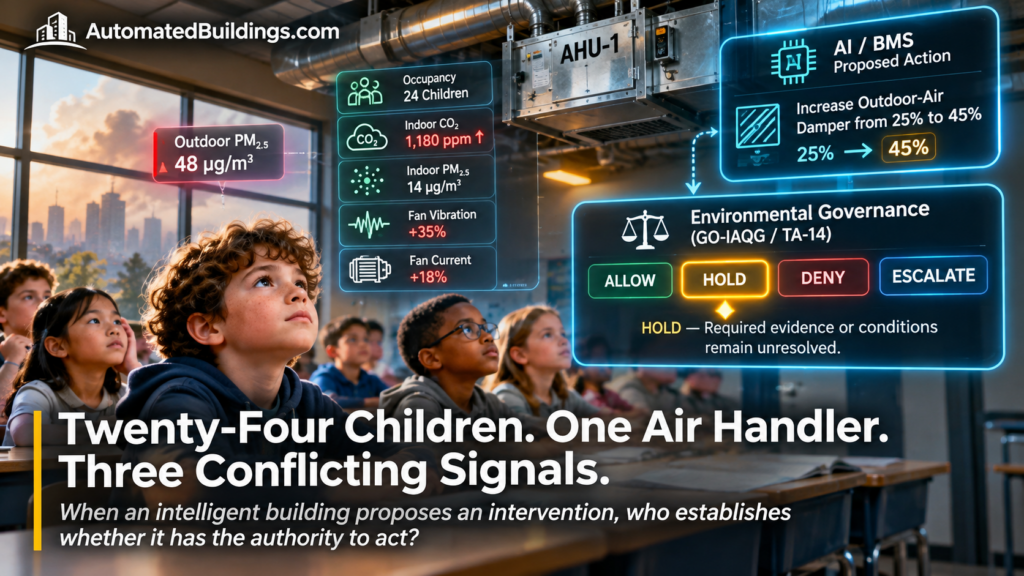
When an intelligent building proposes an intervention, who establishes whether it has the authority to act?
By Greggory Don Butler
Founder, TA-14 Authority Governance Institution
Architect of Environmental Integrity Governance, Atmospheric Integrity Records, and Admissible Execution Architecture
Monday Morning. 9:17 A.M.
Twenty-four children sit inside a third-grade classroom.
Outside, particulate pollution is elevated.
Inside, carbon dioxide is rising.
Above the ceiling, the air handler serving those children is exhibiting abnormal mechanical behavior.
The building automation system recognizes a problem.
Its AI-assisted optimization engine proposes a solution: increase outdoor-air intake.
The calculation takes milliseconds.
But three independent observations are now in conflict.
The classroom needs adequate ventilation. The outdoor atmosphere presents a potential particulate burden. And the equipment responsible for delivering that air may not be performing normally.
The building knows how to move the damper.
But does it know whether it should?
That is the difference between an intelligent building and a governed building.
And it is a distinction our industry can no longer afford to ignore.
This classroom is a hypothetical engineering case. All measurements, actions, and governance determinations are illustrative.
The Numbers Tell Three Different Stories
Consider these hypothetical observations:
| Measurement | Reported condition |
|---|---|
| Classroom occupancy | 24 children |
| Indoor CO₂ | 1,180 ppm, rising |
| Outdoor PM₂.₅ | 48 µg/m³ |
| Indoor PM₂.₅ | 14 µg/m³ |
| Fan vibration | 35% above comparable baseline |
| Fan current | 18% above comparable baseline |
| Outdoor-air damper | 25% commanded position |
These numbers do not independently establish a regulatory violation, medical risk, or mechanical failure.
They establish uncertainty.
Elevated classroom CO₂ may indicate ventilation that is insufficient relative to occupancy, but it is not a complete measure of indoor air quality.
Outdoor particulate measurements matter, but outdoor concentration alone cannot establish the resulting indoor exposure.
Increased vibration and electrical current warrant examination, but neither proves a specific equipment defect.
And commanding a damper to 45% does not prove that outdoor airflow will increase proportionally.
Seven observations. Multiple interpretations. One proposed physical consequence.
The AI can calculate an answer.
But calculation is not authorization.
The Industry Has Combined Responsibilities That Must Remain Distinguishable
Modern building platforms increasingly collect environmental data, interpret operating conditions, diagnose faults, optimize equipment, execute commands, and report successful outcomes.
That integration offers real advantages.
But it introduces a fundamental accountability problem.
When the same system creates the record, interprets the record, executes the intervention, and declares the result successful, what independently establishes that its conclusions are justified?
Separate dashboards do not necessarily mean independent verification.
A successful command acknowledgment does not establish physical performance.
A corrected data point is not necessarily an authentic observation.
And an algorithm’s confidence score does not establish legal, institutional, or operational authority.
This is why TA-14 Authority developed a governance approach that preserves the distinctions between physical reality, recorded evidence, computational interpretation, execution authority, and observed outcome.
The objective is not to replace building automation.
It is to prevent automation from becoming the sole authority over its own consequential decisions.
First: Preserve Reality Before Interpreting It
Through Atmospheric Integrity Records (AIR), TA-14 proposes preserving source-attributed, time-sequenced environmental and equipment observations.
For this classroom, the record would identify sensor sources, timestamps, calibration context, occupancy information where appropriate, equipment conditions, commands, feedback, missing measurements, and uncertainty.
Suppose the outdoor PM₂.₅ value displayed on the dashboard is twenty minutes old.
It may be a valid historical measurement.
But is it admissible as evidence of the outdoor atmosphere NOW?
Suppose the fan vibration is 35% above baseline.
Was that baseline established at comparable fan speed, airflow, and operating conditions?
Without that context, the percentage may be mathematically correct while its engineering meaning remains unresolved.
A measurement is not automatically admissible for every decision.
Admissible Computation Architecture (ACA) addresses whether evidence is sufficiently reliable, current, relevant, and contextualized for its intended computational use.
The principle is straightforward:
Observed is not inferred. Inferred is not authorized.
Second: Let Intelligence Propose
The AI/BMS may evaluate alternatives.
Increase outdoor air.
Adjust an authorized operating sequence.
Request additional measurements.
Identify an equipment fault requiring examination.
Escalate to an authorized engineer.
These are legitimate computational functions.
But every proposed intervention has a different physical consequence.
Changing fan speed is not equivalent to changing outdoor-air intake.
Changing filtration operation is not equivalent to declaring a classroom environmentally acceptable.
And detecting a problem is not equivalent to establishing the authority to intervene.
Intelligence proposes. Governance examines.
That separation is essential.
Third: Examine Authority at the Moment of Execution
TA-14’s Admissible Execution Architecture (AEA) addresses the boundary between a proposed consequence and its commitment to physical reality.
Its governing question is:
Does this proposed consequence have sufficient Admissible Evidence, Applicable Authority, and Established Standing to become reality NOW?
Admissible Evidence asks whether the supporting record is sufficient for this specific action.
Applicable Authority asks which engineering requirements, permissions, operating constraints, and institutional responsibilities govern it.
Established Standing asks whether the actor or system invoking that authority is entitled to exercise it for this consequence under present conditions.
A controller may be authenticated.
An algorithm may be accurate.
A strategy may have been approved yesterday.
None of those facts independently establishes permission to execute today.
Connection is not authority. Prediction is not permission. Previous authorization is not permanent standing.
Four Determinations. Four Different Consequences.
TA-14 distinguishes four governance dispositions:
ALLOW: The proposed consequence satisfies the applicable evidence, authority, and standing requirements within its authorized scope.
HOLD: Required evidence or conditions remain unresolved. The specific proposed action cannot proceed until they are addressed.
DENY: The action conflicts with an applicable prohibition or governing restriction.
ESCALATE: A decision requires authority beyond that delegated to the proposing system.
Return to our classroom.
The outdoor particulate reading may be stale.
The fan’s mechanical condition remains uncertain.
The AI proposes increasing outdoor-air intake anyway.
Determination: HOLD.
Not because increasing ventilation is inherently wrong.
Not because the AI necessarily made a computational error.
But because the evidence needed to justify this particular intervention has not been established.
Importantly, HOLD does not mean shutting down the air handler or suspending legally required ventilation.
Existing safety protections, required operating conditions, and authorized fallback sequences remain applicable.
HOLD concerns the specific proposed consequence.
And there is another critical distinction.
A HOLD displayed on a dashboard is not proof of enforcement.
Only a properly integrated and tested execution boundary can demonstrate that a governed command was actually prevented from proceeding.
That is the difference between documentary governance and operational enforcement.
Execution Is Not Evidence of Success
Suppose the uncertainty is resolved.
The proposal is reexamined and receives ALLOW.
The BAS commands the damper to open.
The actuator reports movement.
Has the classroom’s ventilation problem been solved?
Not necessarily.
Did actual outdoor airflow increase?
Did classroom CO₂ respond?
Did indoor particulate concentration change?
Did the fan remain within acceptable operating limits?
Did the observed environmental outcome match the intended result?
Those questions require post-execution evidence.
TA-14 expresses this responsibility through an eight-link chain:
Reality → Record → Continuity → Admissibility → Binding → Commit → Execution → Outcome
Every link matters.
A command is not an outcome.
A prediction is not proof.
And successful execution does not establish that the original decision was justified.
The Next Autonomous Building Demonstration
The industry should begin testing something more demanding than whether autonomous buildings can optimize themselves.
Give the system a valid authorization.
Then change the conditions.
Introduce a stale sensor reading.
Withdraw a permission.
Alter equipment operating conditions.
Allow the AI to propose the previously approved action again.
Now ask:
Can the system recognize that its original authority may no longer be sufficient?
Can it preserve the evidence supporting its determination?
Can it produce ALLOW, HOLD, DENY, or ESCALATE?
Can HOLD actually prevent the governed action from executing?
Can the entire decision and its physical outcome be reconstructed afterward?
That is an engineering examination of accountable autonomy.
And it is the kind of demonstration the next generation of intelligent buildings should be expected to withstand.
Why Twenty-Four Children Matter
The children in this classroom cannot inspect the air handler.
They cannot verify the particulate sensor.
They cannot evaluate the AI model.
They cannot determine whether the damper command will produce the intended airflow.
Yet they experience the physical environment resulting from those decisions.
Their protection depends on competent engineering, appropriate standards, reliable evidence, accountable authority, and verified operational outcomes.
Global Open Indoor Air Quality Governance (GO-IAQG) is TA-14’s proposed framework for examining these relationships through distinct responsibilities:
Physical Reality → AIR → ACA → AI/BMS → AEA → Physical Execution → Observed Outcome → New AIR
This is not another IAQ score.
It is not a replacement for ventilation standards, life-safety systems, or professional engineering judgment.
It is a proposed governance architecture intended to make consequential environmental decisions more transparent, examinable, and accountable.
The Building Can Think. But Can It Justify Acting?
Ken Sinclair and the AutomatedBuildings community have spent decades helping the industry understand the evolution from conventional automation toward increasingly autonomous buildings.
That evolution is accelerating.
Buildings are gaining the ability to observe, predict, diagnose, optimize, and act with less human intervention.
But the next breakthrough cannot be measured only by how independently a building operates.
It must also be measured by whether its consequential decisions can withstand scrutiny.
The question is no longer simply:
Can the building act without asking a human?
The question is:
Can the building establish that its proposed action has sufficient evidence, applicable authority, and established standing to become reality NOW?
Twenty-four children.
One air handler.
Three conflicting signals.
The AI may propose an answer in milliseconds.
But the building must still establish whether that answer is authorized to become a physical consequence.
Because the final authority on what actually happened is not the algorithm’s prediction.
It is the physical world.
No admissible evidence. No admissible execution.
About the Author
Greggory Don Butler is the founder of TA-14 Authority Governance Institution and architect of Environmental Integrity Governance, Atmospheric Integrity Records, and Admissible Execution Architecture. His work examines how evidence, authority, and standing govern consequential decisions across HVAC, indoor environmental quality, buildings, and autonomous systems.
TA-14 AI Governance Exchange: https://www.ta14exchange.com/
Editorial disclosure: This article presents a hypothetical engineering scenario and proposed governance architecture. It does not claim a production deployment, certified safety system, independently validated environmental protection outcome, or regulatory approval. Real-world implementation requires appropriate engineering validation, lawful authority, and tested integration.