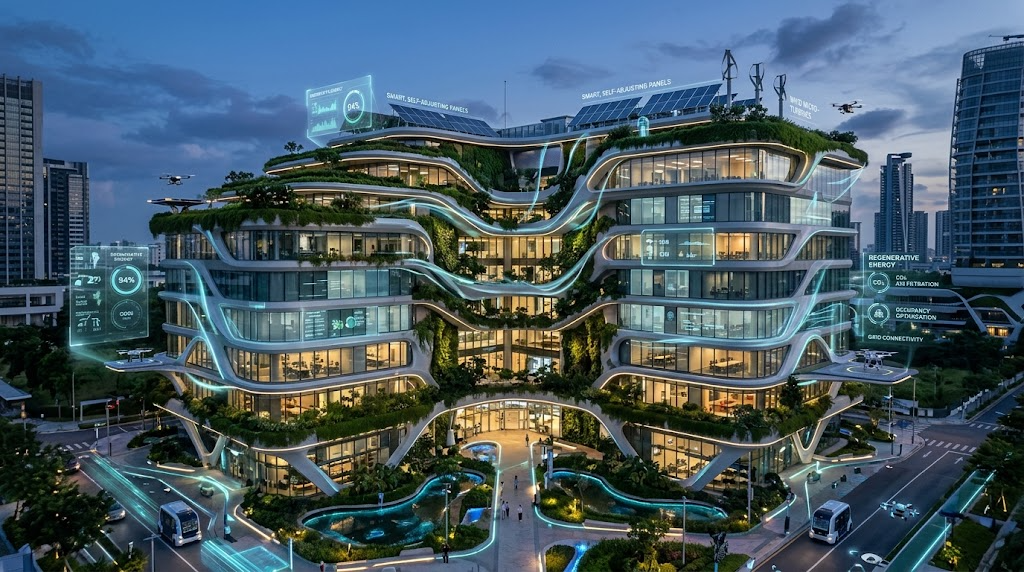
An autonomous building is a facility designed to monitor, adapt, manage, and optimize its own physical operations—such as HVAC, lighting, energy consumption, and indoor environmental quality—with little to no continuous human intervention.
While traditional automated buildings operate on fixed schedules and rigid, rule-based algorithms, an autonomous building functions more like a closed-loop, self-driving system. It perceives its internal and external conditions, reasons about potential outcomes, and takes real-time actions to balance energy efficiency, occupant comfort, operational resilience, and grid demands.
Key Capabilities of an Autonomous Building
- Sense & Perceive (Rich Context Awareness)
- Dense Sensing: Continuously captures real-time data on indoor air quality (CO₂, VOCs, PM2.5), occupancy patterns, solar gain, and ambient temperature.
- External Integration: Pulls in external data streams such as weather forecasts, grid carbon intensity, utility time-of-use pricing, and occupancy calendars.
- Reason & Predict (AI & Physics-Informed Modeling)
- Predictive Control: Moves beyond reacting after a room gets hot or cold. By using predictive models (such as Model Predictive Control or digital twins), it anticipates thermal loads and occupancy spikes hours in advance.
- Scenario Planning: Simulates the effects of pre-cooling, shifting non-critical loads, or discharging onsite battery storage to minimize peak-demand charges.
- Act & Optimize (Continuous Closed-Loop Control)
- Dynamic Self-Tuning: Continuously adjusts setpoints, airflow volumes, water temperatures, and equipment sequencing in micro-increments rather than relying on static seasonal setpoints.
- Multi-Objective Tradeoffs: Autonomously balances conflicting priorities, such as keeping energy use low while maintaining strict fresh-air ventilation and occupant thermal comfort.
- Self-Diagnose & Self-Heal (Automated Fault Management)
- Fault Detection and Diagnostics (FDD): Detects mechanical degradation, leaking valves, simultaneous heating and cooling, or sensor drift early.
- Automated Mitigation: Can isolate malfunctioning subsystems, reconfigure duct or zone airflow to bypass a failing damper, and automatically generate detailed work orders with root-cause context for technicians.
- Interact with the Grid (Grid-Interactive Efficient Buildings / GEB)
- Demand Flexibility: Acts as a distributed energy resource (DER) by modulating load, coordinating with rooftop solar, EV chargers, and onsite battery storage, and participating in automated demand response programs.
The Evolution: Automated vs. Smart vs. Autonomous
| Dimension | Conventional Automated Building (BAS/BMS) | Smart / Connected Building | Autonomous Building |
| Logic | Static rules, fixed time-of-day schedules, basic PID loops | Cloud dashboards, anomaly alerts, setpoint recommendations | Dynamic, predictive, closed-loop machine learning & self-tuning |
| Human Role | Operator manually changes schedules, setpoints, and investigates issues | Operator reviews analytics and executes recommendations | Operator sets policies, boundaries, and objectives; system runs independently |
| Data Context | Siloed, proprietary point addresses (e.g., AHU1_DAT) | Centralized data lakes, basic tagging | Semantic data standards (e.g., Brick, Project Haystack, ASHRAE 223P) enabling machine interpretability |
| Response to Change | Blindly follows programmed scripts regardless of weather or occupancy shifts | Flags deviations for operator intervention | Adapts instantly to real-time internal and external condition shifts |
Foundation Technologies Enabling Autonomy
- Semantic Data Modeling & Ontologies: For AI agents and control software to reason about a building, data cannot simply be arbitrary register addresses. Semantic frameworks (like Project Haystack, Brick Schema, and ASHRAE 223P) provide standardized machine-readable context about what every sensor is, where it is located, and how equipment connects downstream.
- Edge Intelligence & Open Frameworks: Running lightweight machine-learning models directly at the edge or plant controller level ensures low-latency control and operational continuity even if an internet connection drops.
- Agentic AI & Supervisory Control: Supervisory software agents that communicate via standardized APIs (like UDMI or BACnet Secure Connect) to orchestrate subsystems across lighting, HVAC, access control, and energy storage.
- Autonomy-as-a-Service (AaaS): Shifting from one-off software licenses and static integration to continuous, cloud- or edge-delivered autonomous supervisory services that evolve over time.