
November’s Monday Live! theme is autonomous buildings, and the opening discussion began with a deceptively simple question: What does “autonomous” actually mean?
Buildings have been making decisions for decades. They adjust temperatures, manage airflow, respond to schedules, and generate alarms. Yet most still depend on people to interpret problems, coordinate responses, and determine whether an intervention worked. The distinction between automated and autonomous may have less to do with adding technology than with how much responsibility a system can reliably assume.
An AI assistant introduced an interesting phrase during the discussion: autonomy as a service. It fits the fragmented nature of buildings, where individual systems and services could become autonomous without requiring an entire building to change at once. There is an opportunity for businesses to deliver autonomy around specific functions, whether optimizing equipment, managing maintenance, or responding to occupancy.
The challenge is not convincing the industry that autonomy is possible. It is demonstrating where it creates value, how that value can be measured, and what evidence proves the system is working.
A truly autonomous building should be boring. It simply works, without constant attention or unnecessary intervention.
In some respects, buildings have been moving toward that ideal for generations. Elevators transitioned away from human operators, while building controls routinely manage fans, pumps, and temperatures around the clock. But much of this activity remains automated rather than autonomous. Systems execute predetermined sequences, even when those sequences no longer reflect actual conditions.
Occupancy offers a straightforward example. A conference room may be conditioned according to a schedule, regardless of whether anyone arrives. Connect its booking calendar to presence sensors, and the system can prepare the room when needed, respond to actual use, and return to standby afterward. Add lighting, shades, ventilation, and multiple zones, and that simple example becomes a much more interesting coordination problem.
Dynamic responsiveness is part of the distinction, but it is not sufficient on its own. Advanced automation can already react to changing inputs. Autonomy goes further when a system can evaluate conditions, choose appropriate actions within established boundaries, and determine whether those actions achieved the intended result.
Building systems are remarkably good at identifying problems. What happens afterward is another matter. An alarm may sit unnoticed, generate another notification, or require an operator to investigate, create a work order, dispatch a technician, and confirm that the repair was successful. Each disconnected step creates an opportunity for delay or failure.
The discussion explored how AI-enabled workflows could connect those activities. A system might detect abnormal equipment performance, evaluate likely causes, initiate an approved response, and then examine subsequent operating data to verify that the problem was resolved. Earlier examples of overnight self-testing in conference room audiovisual systems demonstrated a similar principle: identify faults before users arrive and give maintenance teams time to correct them.
This is where the conversation moved beyond traditional control sequences. Building automation has historically depended on experts translating their knowledge into static rules. Those rules may remain in place for years, even as equipment ages, seasons change, and operating patterns evolve. AI offers new ways to capture expertise, recognize emerging patterns, and adapt recommendations or control strategies over time.
That does not mean turning buildings into uncontrolled experiments. Learning systems still need engineering constraints, safety limits, and clear methods of validation. The important advancement is the ability to move beyond detecting a problem toward understanding, acting, and verifying, with each completed cycle providing better information for the next decision.
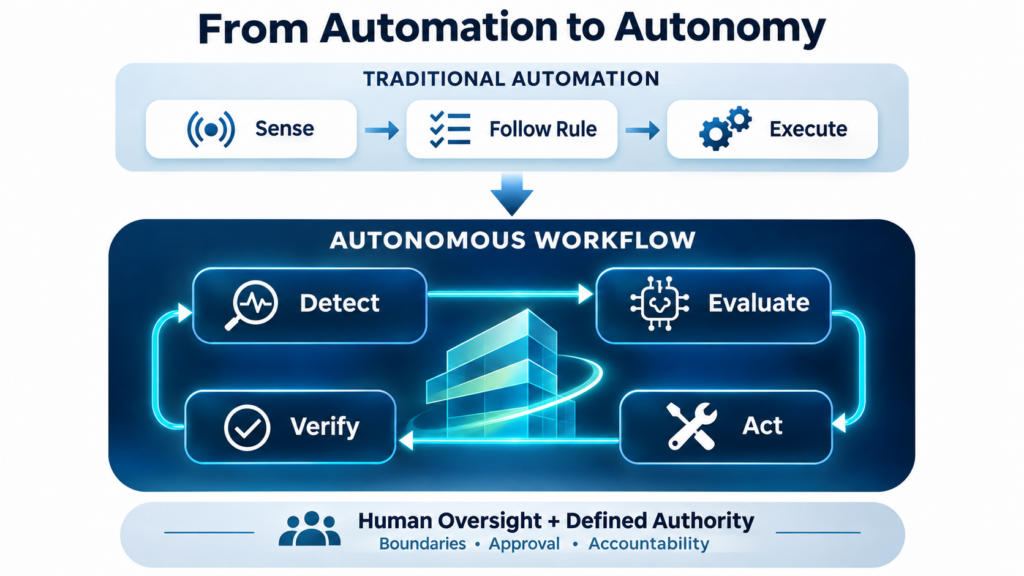
Trust quickly became one of the discussion’s central themes. In an informal show of hands, few participants were comfortable with AI operating a building entirely on its own. Support increased substantially when a human remained involved in consequential decisions. That response suggested an important distinction: reducing routine human intervention is not the same as removing human authority.
Much of the difficulty begins with building data. Information remains scattered across disconnected systems, and the rules governing those systems are not always accessible. Point names may be cryptic, equipment relationships poorly documented, and operating conditions difficult to interpret. AI might turn an alarm into a useful explanation of what is happening and why it matters, but it can also produce convincing answers from incomplete or incorrect information.
This makes standardization, semantic context, and access to reliable operational data essential to progress. A system needs to understand not only what a point reports, but what equipment it represents, what that equipment serves, and how its operation affects the rest of the building. Intelligence without context can become another source of operational risk.
There is also the question of authority. Autonomous for whom? Hospitals, laboratories, pharmaceutical facilities, and hazardous manufacturing environments have different requirements for oversight and liability than a conventional office building. Ownership can complicate even routine decisions. A central plant may belong to one party while the equipment distributing its output belongs to another. A system may be technically capable of making an adjustment without having the authority to do so.
Before granting autonomy, someone must define the boundaries. What can the system decide independently? What requires approval? Who is responsible when something goes wrong? These are governance questions as much as technical ones.
A recurring message was to resist falling in love with the technology. The more productive approach is to identify a genuine owner problem and work backward from it.
Reducing unnecessary equipment runtime, resolving recurring comfort complaints, detecting refrigeration failures, or verifying maintenance outcomes are all reasonable starting points. Each use case exposes the information required to solve it, the data that is missing, and the systems that must communicate. Rather than waiting for a perfectly integrated building, a useful application can provide the justification for improving its underlying infrastructure.
The group favored an incremental approach, drawing a comparison with autonomous vehicles. Technologies for sensing, braking assistance, and steering support developed as individual capabilities long before the broader ambition of automated driving could be addressed. Buildings may follow a similar path, with autonomy introduced where conditions are understood, responsibilities are clear, and outcomes can be demonstrated.
The November series will continue by exploring what a fully autonomous building might look like, the path toward open and interoperable autonomy, and early examples of successful applications. Four more weeks remain to examine the possibilities and the limitations.
Perhaps the most useful question emerging from this first discussion is not whether buildings can make decisions. They already do. It is which decisions they should be trusted to make, under whose authority, and with what evidence that the result was right.
The week’s news provided a timely reminder of the stakes. Cyber incidents targeting supermarket refrigeration controls in Europe raised concerns about the security of connected operational systems. The same remote connectivity that enables monitoring and optimization can create vulnerabilities when poorly protected. At the same time, refrigeration monitoring demonstrates the value of connected systems by identifying temperature problems early enough to protect valuable inventory.
These examples reinforce the need to design cybersecurity and operational monitoring together rather than treating them as separate responsibilities.
The Coalition for Smarter Buildings has a town hall scheduled for Thursday, November 5, with planned discussions covering cybersecurity, digital building profiles, and a beta total cost of ownership tool. The proposed approach lets owners select building improvement measures and examine modeled financial outcomes, while giving vendors a way to demonstrate the potential impact of their technologies.
Friday’s planned joint discussion between buildingSMART and building data semantics groups will explore alignment around open standards for building operations. Both conversations connect to the challenge of autonomy: making building information accessible, understandable, and useful across systems.
What Is Monday Live!
Monday Live! is a free weekly industry roundtable held Mondays at 3 p.m. ET, where building automation professionals explore the future of smarter buildings. Views shared are personal, not institutional. Session details, presentations, and past discussions are available at mondaylive.org.